I watch people meet the name for the first time. There is a small frown. Ten letters, half of them vowels, a shape that looks Greek and is. Then the logo does its trick: the first two letters become an eye, and the frown turns into the other thing, the head tilt, the second read. That second read is the entire design. I wanted a name that does not hand you its meaning on the first pass, because a name that does is used up on the first pass. A name that makes you do a little work stays open in your head after you close the tab.
This is the long version of why I chose it. It goes further into the Greek than a business article needs to. I studied Attic Greek and philosophy in college and I have been waiting a long time for a reason to use both at work. This is the reason.
The entry
eidomai · εἴδομαι · verb, Ancient Greek, middle voice.
Pronunciation. In Homer's Greek it is roughly AY-doh-my, three syllables, stress on the first, and classicists still say it that way. I say EYE-dom-eye, the way Nike says Nike. I accept both, plus whatever your uncle comes up with. There is one version I correct, and the reason is at the end of this piece.
Meaning. To be seen. To appear, to show yourself, to come into view. By extension, to seem, and in Homer, to make yourself look like someone. When Athena walks into Ithaca to get Telemachus moving, the poet says she came Μέντορι εἰδομένη, appearing as Mentor, in his body and his voice. The verb is what a god does when they choose to be visible to a mortal, in a form the mortal can take in.
Root. Proto-Indo-European *weid-, to see, and by the oldest metaphor in the family, to know. Its descendants are most of the words we use for both. Greek eidos, the form, the thing seen. Idea. Eidolon, image, later idol. Oida, I know, which is grammatically a perfect tense: I have seen. Latin video and visio. Sanskrit veda, knowledge. English wit, wise, witness. History, from Greek histor, the one who knows because he was there and saw it.
That last cluster is the one I keep coming back to. In this family of words, knowing and seeing are the same act in different tenses. You know a thing because at some point it was in front of you. An AI engine knows a business the same way. It has seen the pages, the listings, the reviews, the mentions, and its answer is the perfect tense of that seeing. If it has not seen you, it does not know you. It will say so, or worse, it will make something up. I have read enough AI answers about my own clients to know which one is more common.
Middle voice, which is the product in one grammatical feature
Greek verbs come in three voices. Active: I see. Passive: I am seen. And a third one, the middle, where the subject is inside the action and changed by it. Eidomai is a middle. It does not mean "I see." That verb is horaō. It does not quite mean "I am seen" either, as something done to you. It means "I appear." "I show." "I come into view." The subject is the thing becoming visible, and it has a hand in becoming so.
That is the exact posture of a business inside an AI answer. You are not the one looking. You are not passively looked at either, because what the engine sees is made of things you published, or failed to publish, or let go stale. You are the one appearing, or not, in a form the engine can take in. I could not have written a better brief for the product than the grammar of the verb. Be seen, correctly, and have a say in how.
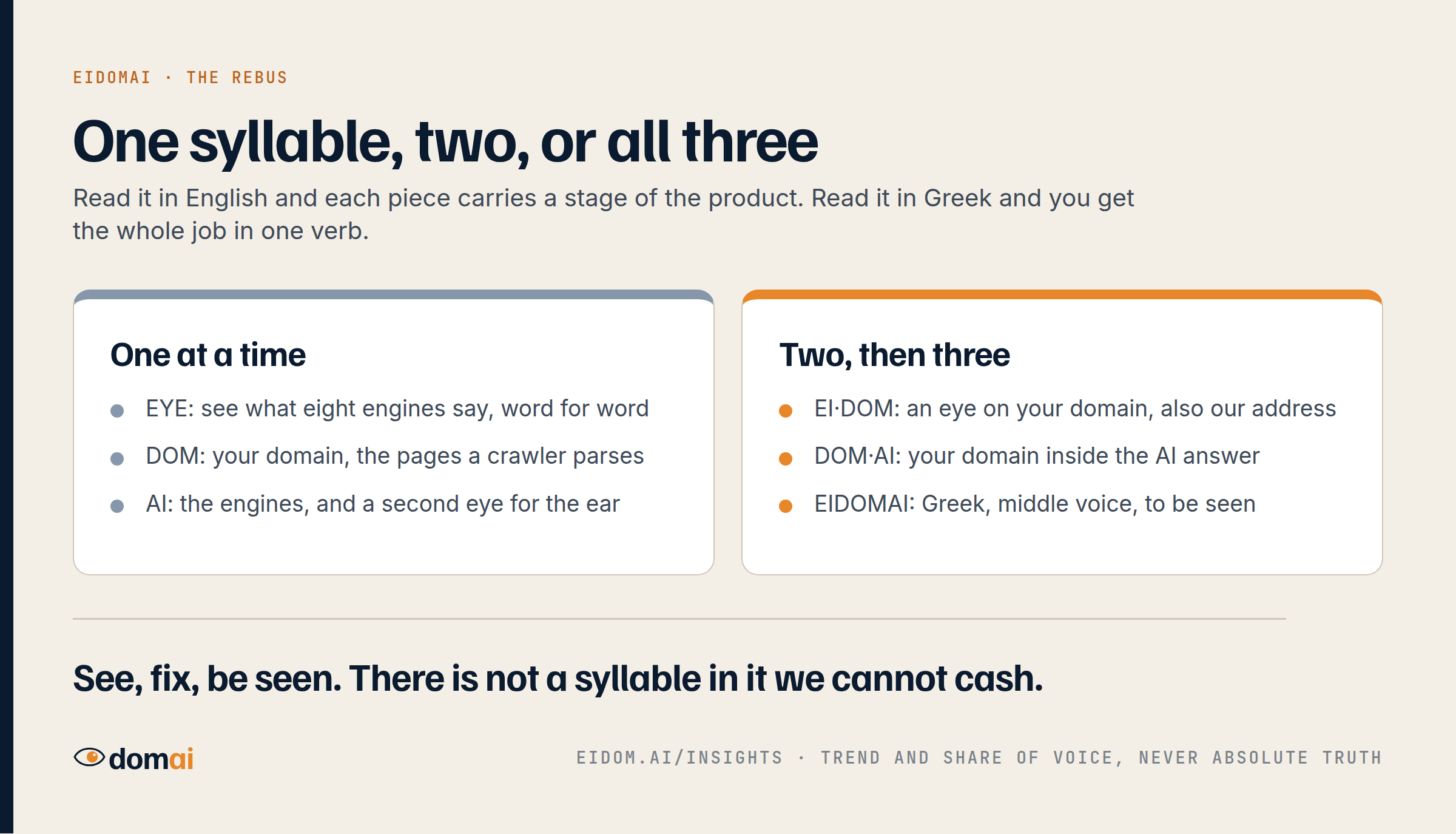
The rebus
Now the English reading, the one the logo insists on. Replace the first two letters with an eye and the name breaks into three pieces that each mean something on their own.
EYE. To see. That is the first stage of everything I built: before anyone can fix an answer they have to see it, word for word, from every engine. Also the homophone: I. First person. Whose name gets said when a customer asks.
DOM. Domain, in the plain sense: your website, the thing that carries your name. And in the older sense, Latin domus, the house, and dominium, what you hold and are responsible for. The suffix in kingdom and freedom, a state of being. And, for anyone who has built a page, the DOM: the Document Object Model, the tree of elements a crawler actually parses when it reads your site. The pages Eidomai gets written land in that tree. I did not put that syllable there for decoration.
AI. The engines. The eight of them we ask every month. The suffix on our own address. And, for the ear, a second eye. The name begins and ends on the same sound. The line under the logo says exactly this: it starts with an eye, it ends with AI.
Read two syllables at a time and the name keeps working.
EI·DOM. An eye on your domain. What is watching, and what is being watched. It is also our address: eidom, in the .ai space.
DOM·AI. Your domain in AI. The plain reading is where your site stands inside eight answer engines. The reading most people hear first is louder: dominate AI. I am not going to pretend that was an accident. I will tell you what I mean by it. The product does not promise a contest anyone wins. It finds the customer questions where you are absent or misdescribed and gets the page written that earns a place in the answer. Dominance, in my house, is a map with more green on it than last month.
Read all three at once and you are back at the Greek: to be seen.
Things hiding in the letters
This section is for people who enjoy this sort of thing. I am one of them. Nobody else needs it.
The last three letters, reversed, are I am. The first two, in Greek, are εἶ, you are. The name runs from second person to first: you are, then, backwards, I am. A business becomes an "I" in an answer only after an engine has decided "you are."
Inside the ten letters sit idea, media, aim, mode and amid. No domain, which needs an n, so that syllable has to carry the word on sound alone.
Eidos, the noun from the same root, is Plato's word for the form of a thing, the shape it has when seen clearly. Aristotle turns it into the species. English takes eidetic from it, the kind of memory that holds an image exactly. The best outcome of a wrong AI answer is that it becomes eidetic in the other direction: the engine holds the corrected image exactly, and keeps holding it.
And the shape on the page. The name is symmetrical enough to read as a palindrome to the ear, eye · dom · eye, without being one to the eye. That gap, between what it sounds like and what it looks like, is the itch. It is the same reason a rebus works at all. The picture and the word disagree just enough that you have to hold both.
Why I wanted a name that starts as a question
There is a reasonable case for descriptive names, and most of this category made it. The tools around us are called things that tell you what they do, or things that are simply pleasant. Both are fine strategies. Neither is mine, for three reasons.
The first is memory. Things you work out for yourself stick better than things you are told. Psychologists call it the generation effect: a word you had to produce is remembered better than a word you only read. A name that gives up its meaning in three stages is a name you generate three times. The frown is the price. The retention is what it buys.
The second is the unfinished loop. A puzzle you have partly solved is a puzzle you keep returning to. Most people get eye and AI on the first pass. Dom takes a beat. The Greek takes a search. I built the name so the last piece arrives later, somewhere else, when you are not looking at it.
The third is that the name is a specification. Every piece of it is a piece of the product. Eye: measure what eight engines say, verbatim, every month. Dom: fix it on your own domain, in pages a crawler can parse, with every fact verified first. AI: the engines that read the result and, next month, answer differently or do not. See, fix, be seen. There is not a syllable in it I cannot cash.
The precedents
Names that ask for a second read have a long record. Nike is a Greek goddess and most of the world says it wrong, and the company let them. Google is a misspelling of a number. Häagen-Dazs is two invented words with an umlaut Danish does not use. Kodak was assembled from letters its founder liked the sound of. None of these told you what the thing did. All of them gave you a small private moment of working it out, and that moment did the work a slogan usually does.
Eidomai belongs to the first family, the found word. It is a real verb that real poets used for a real act: becoming visible, on purpose, in a form the viewer can understand. I did not invent the meaning. I borrowed a word that already meant the job.
The one pronunciation I correct
Say it any way you like, but say all of it. Without the last syllable the name is an eye on a domain with no engine in the picture, and that describes a different and older business: making a website findable. That is search optimization. Ten thousand people do it and I was one of them for a long time. The last two letters are where the work changed. So the name never gets shortened in anything we write, and if you catch one of us doing it, you have found the only wrong answer about the name that I will fix on the spot.
Everything else is yours to read however you want. That was the idea.