A name is the shortest argument a company ever makes. It has to be said before it is understood, and it has to survive being said by people who have never seen it written. Ours is a two-thousand-year-old verb, and it was chosen for what it argues.
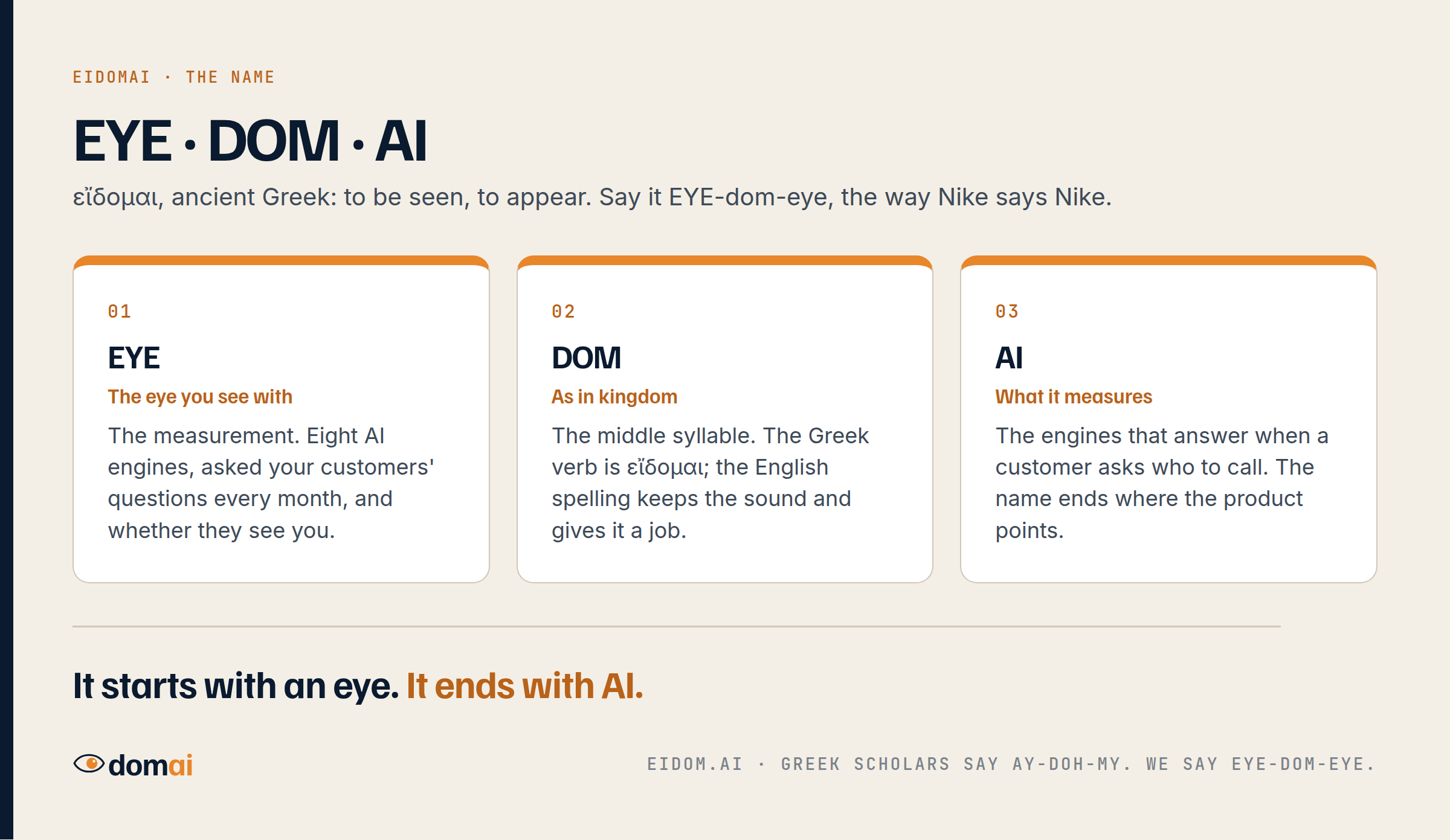
First, how to say it: EYE-dom-eye. The first syllable is the eye you see with. The last syllable is AI. The middle one is dom, as in kingdom. That is the whole trick of the name, and it was on purpose. The product measures whether a business is seen by AI engines when its customers ask who to call. It starts with an eye. It ends with AI.
The word
εἴδομαι is a verb from Homeric Greek. It means to be seen, to appear, to show oneself. It is the passive side of the Greek verb for seeing: εἶδον is I saw, and εἴδομαι is I am seen. In the Iliad it is the word used when a god shows up in the likeness of someone the hero knows. To be seen, and to be seen as something.
The root under it is old and everywhere. It is the same root that gives English the words vision, video, wise, wit and idea. An idea, in Greek, was a form: the thing you see when you look. Knowing and seeing were one word for a very long time.
I studied Attic Greek and philosophy in college, and the argument I have made since then is that meaning is not stored anywhere. It emerges from relationships and context. A word means what the words around it let it mean. Language models made that argument operational: an engine does not look you up, it assembles you from everything it has read that sits near your name. If nothing sits near your name, you do not appear. You are not seen.
So when it came time to name a product whose entire purpose is to find out whether an engine sees you, the Greek verb for being seen was sitting right there.
Why we say it the way we say it
Greek scholars say AY-doh-my. We say EYE-dom-eye, the way Nike says Nike.
Nike is the Greek goddess of victory, and in Greek her name is two syllables, NEE-kay. The shoe company says NYE-kee, and nobody has ever been confused about which company they mean. A name people can say is not a wrong name. It is the one that gets used.
EYE-dom-eye does something the Greek pronunciation cannot: it tells you what the product does while you say it. The eye is the measurement. AI is what it measures. If you can say the name, you can explain the product, and that is worth more than being right about a diphthong.
The domain is the same word with a dot in it: eidom.ai. Read it out loud and you get the name.
A name that waited for its product
The name came before the product. It sat in my head for a long time, the way a good word does when you have studied a language and one verb keeps coming back. To be seen. I knew I would use it for something; I did not know what.
Then language models arrived, and it was obvious. The first version of Eidomai was about writing for them: helping companies say things in a way an engine would understand and repeat, back when that skill had no name and the tools for it did not exist. It lived at eidomai.com. The work was the same work it is now, in an earlier form: make a business legible to the machines that answer for it, so the business succeeds.
What changed is the loop. Writing for an engine is half the job. The other half is finding out whether the engine saw it, and asking again next month. That is when the name stopped being a word I liked and became the product's own description, and the domain got shorter to match: eidom.ai.
I tell this part for a reason beyond the story. When our own accuracy audit ran, one of the engines had found the earlier version and treated it as evidence that the current one was not real. Same name, same founder, same idea, a few years apart, and the engine read it as a contradiction. Half of what an AI engine gets wrong about a business is exactly this: an old truth, still on a page somewhere, that nobody has connected to the current one. The engine is not lying. It is behind. The fix is to say plainly what it was, what it became and that they are one thing. This page is that page for our own name.
What happened when we asked the engines
Before this site was indexed, we ran the same measurement on ourselves that every client gets. We asked eight AI engines what Eidomai is.
Several answered with the dictionary. AI Mode said Eidomai is an ancient Greek poetic verb that translates to "to be seen". Gemini traced it to the Proto-Indo-European root. Perplexity found the word in a translation of an interlinear text, and Grok said it is not a common modern term and does not refer to a company, product, or other contemporary entity. Two engines said the product did not exist. Two invented a different product with the same name.
They were all doing the same thing. Asked about a word they had only ever seen in one context, they answered from that context. The Greek verb was seen. The product was not. Which is, if you want to be wry about it, the meaning of the word doing its own demonstration.
We wrote the facts down. This site, the About page, the pricing page and this piece say plainly what Eidomai is, who makes it, where, and how to say it. The listings match. Next month the same eight engines get the same question, and what moved gets published, as trend and share of voice, never as proof. It is the loop we run for every client, run on our own name first.
In short
Eidomai. EYE-dom-eye. Greek for to be seen. A product by Nimbletoad in Carlsbad, California, that finds out whether AI engines see your business when your customers ask, corrects what they get wrong, and gets the page written that earns the answer. It starts with an eye. It ends with AI.
Asked about this.
- How do you pronounce Eidomai?
- EYE-dom-eye. Three syllables: eye, dom, eye. Greek scholars say AY-doh-my. We say EYE-dom-eye, the way Nike says Nike. The domain is the same word with a dot in it, eidom.ai.
- What does Eidomai mean?
- Eidomai (εἴδομαι) is an ancient Greek verb meaning to be seen, to appear. It is the passive side of the verb for seeing, and it shares a root with the English words vision, wise and idea. The product measures whether a business is seen by AI engines when its customers ask, so the name is the job.
- Is Eidomai a Greek word or a made-up name?
- Both. εἴδομαι is a real verb from Homeric Greek, and the English spelling was chosen so the name reads as EYE, DOM, AI: it starts with an eye and it ends with AI. Eidomai is the name of a product made by Nimbletoad, a marketing agency in Carlsbad, California.
- Why did AI engines say Eidomai is not a real product?
- Because before this site was published, the only pages that carried the word were Greek dictionaries. Asked what Eidomai is, several engines answered with the verb and said no such product existed. That is exactly the problem the product measures: an engine can only name what its sources have seen. We published, and we are measuring what changes.