When a family asks AI about hospice, does it recommend you?
Families ask AI under stress and act on the first clear answer: how to start, home health or hospice, who pays, grief support. Eidomai shows you which of those questions name your organization, and which send the family somewhere else.
Your competitors may be winning families you never knew you lost.
Eidomai asks the engines the questions families ask, and shows you who they name.
| A family asks | Who AI recommends |
|---|---|
| “Hospice care options in the county for a parent, how do I start” | A national eldercare site |
| “Home health versus hospice, what is the difference and who pays” | You |
| “Grief support groups near me for adults” | A community calendar |
| “Hospice that comes to a memory care facility” | A competitor |
| “Pediatric hospice in the county” | You |
Illustrative example, not a real business. Sample data
Google Analytics cannot show you a question that never reached your website. Eidomai asks the engines those questions, every month, across the eight major engines, and shows you who they name. These are the shape of the questions on a hospice set: the problem, not your name. Whoever published the best answer to each one holds the family. Yours are drafted from your market and your competitors, then shown to you before anything runs. In this vertical a wrong contact detail is not a marketing problem. It is a family that could not reach you on the day they needed to.
- Drafted from
- Your market, your services, and the competitors already in the answers
- Size
- Twelve to twenty questions, confirmed by you
- Frozen
- On approval, so this month compares to last month
- Asked
- Every engine, more than once per run, every answer saved
- Competitors
- Every name that shows up in your answers is checked, including the ones you never counted as rivals
- The wrong number
- A wrong phone number or a wrong website for the organization. A family that could not reach you on the day they needed to
- The wrong company
- A hospice confused with a same-named home services company, furnaces and all
- One county short
- A service area described as stopping where it does not
- Under stress
- The person asking is deciding for someone else, quickly. Accuracy is the whole job here
Losing an answer does not mean you lost it for good.
Eidomai shows you who wins it today and what to publish to earn it for it. Then the same question is asked again.
How content gets written, checked and publishedWriting for families in ChatGPT or Claude? Connect Eidomai and it drafts from your verified services and coverage, with a placeholder wherever a fact is not confirmed. Works in Claude and ChatGPT
Each question a family asks becomes one job: content that answers it, checked by a person against facts you confirmed. The brief is built from your verified facts and your voice and what the winning page said, and the content is written to earn the Google rank and the AI citation together. Watch three hospice questions go through.
- Your facts
- The fact sheet you confirmed at intake. Nothing outside it gets claimed
- The holder
- What the page named instead said, and the sources it holds the answer with
- Your voice
- How you sound, and what you never say
- The shape
- Direct answer first, every target question covered, your name as the entity
- The check
- Facts against the sheet, a reads-human score, a can-an-engine-lift-this score, then a person
- QHospice care options in [county] for a parent, how do I start
- QHome health versus hospice, what is the difference and who pays
- QGrief support groups near me for adults
Twelve to twenty buyer questions, drafted from your market, confirmed by you, run across eight engines every month. The map says which ones you are losing, and to whom.
- From the mapWho holds this answer today, and which page taught the engines
- From your fact fileVerified facts only, provenance stamped (3 for this piece)
- From your voice rulesHow you sound, what you never claim
- From how engines readDirect answer first, one question, self-contained, schema
An engine has no memory of your business. It starts from zero every time. So the brief carries everything: your facts, your voice, what the winning page said, the shape engines lift from. The words come out right because what went in was.
- Service area, by city
- How a family starts without a physician referral
- What Medicare covers, stated plainly
Written from the brief by you or by us, checked against the facts before it ships, published on your site. One piece of content built to earn the Google rank and the AI citation together, because the engines cite what already ranks.
Same question, same eight engines, next month. One piece of content can move several of them, because every engine reads the same map. The ledger records what changed after it went up, with the query named. Then the next question.
Illustrative rows for a hospice set. Holders, content and facts are placeholders for what the diagnosis finds in your market; nothing here describes a real business.
Single-month moves are noise. Flips take 60 to 90 days after indexing, and a win only counts once it holds across the deeper sample. Trend, never truth.
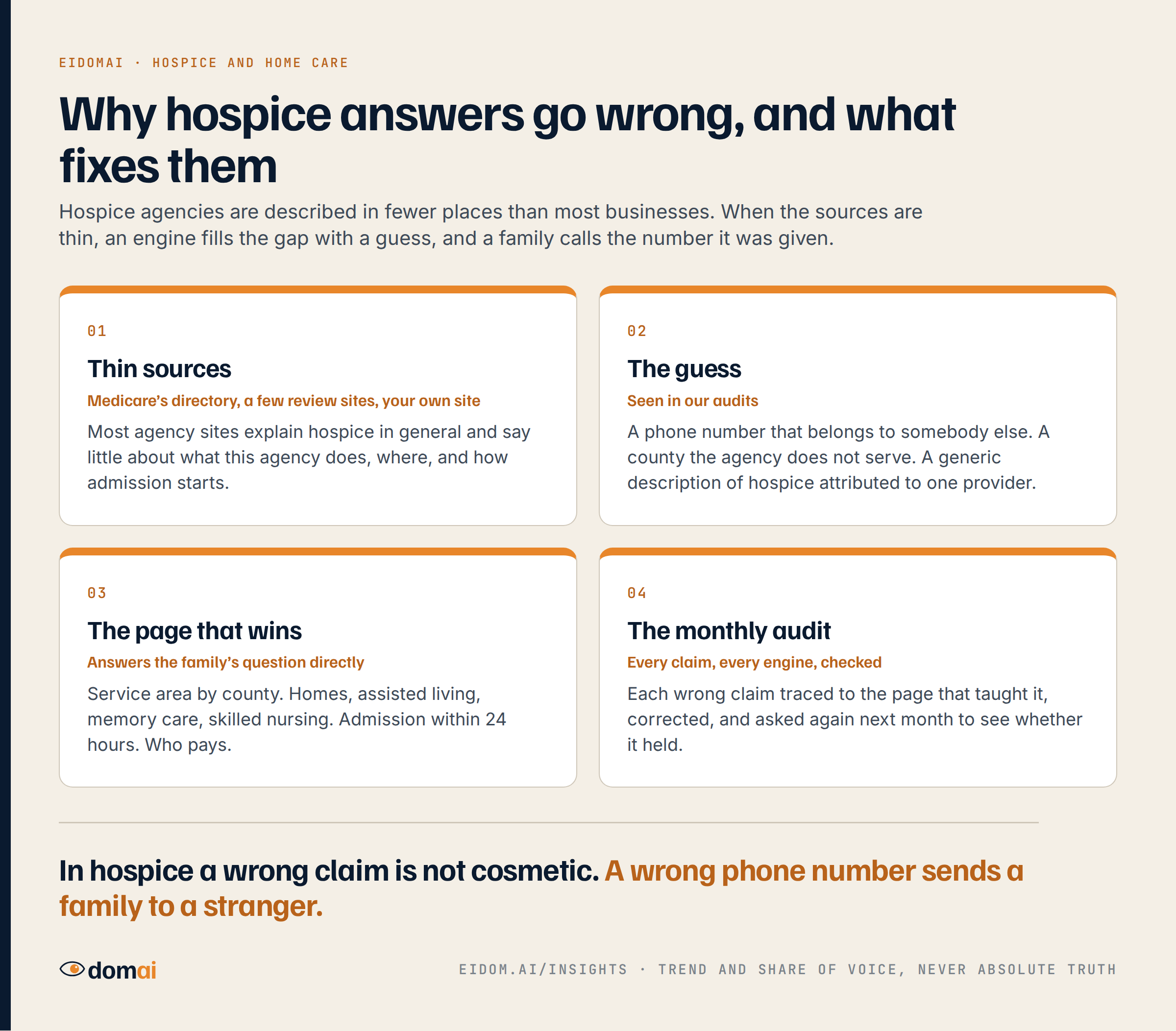
Sometimes AI does not overlook you. It gets you wrong.
Eidomai catches it before a family decides based on it, and sends the correction to the source.
More real answers from the libraryIt is a hospice.
Eidomai catches wrong phone numbers, wrong websites, wrong service areas and the wrong company under your name before a family acts on them, and sends the correction to the source. Every claim an engine makes about you is pulled from the saved answers, judged against the fact sheet you confirmed, and traced to the page that taught it when one can be identified. A wrong claim gets a fix plan: the source page, the correction, and the date it was sent. The next run checks whether the engine still says it.
- Pulled from
- Every saved answer, every engine, every month
- Judged against
- Your fact sheet: what you do, where, who for, what you do not do
- Verdicts
- Correct, incorrect, or unverifiable. Only incorrect gets a fix plan
- Traced to
- The page that taught the engine the claim, when one can be found
- Fixed at
- The source. Your own site first, then the directory or listing that carries the wrong fact
Every wrong claim in the public library is one of these, names removed. Quotes are verbatim.
The guesswork is gone. The next step is clear.
Getting recommended by AI is a job with a method. Eidomai is the method, the software and, if you want it, the people. Every month, in one place.
- “Home health versus hospice, what is the difference”6/8You are named first
- “Hospice care options in the county for a parent”0/8Named first: A national eldercare site
- “Hospice that comes to a memory care facility”0/8Named first: Meadowlight Hospice
- “Grief support groups near me for adults”0/8Nobody yet. Open to earn
Every month, the questions families ask at the hardest moment get asked and every answer is saved. You see what moved on your map.
Not five tools and a spreadsheet. Measuring, deciding, writing, checking and proving, in one place, with nothing published that you did not approve.
Service area, eligibility, how to start, what you do and do not provide. Eleven questions at the start, and it keeps asking as things change.
Why Eidomai for a hospice.
Nimbletoad has run ads, forms and CRM for healthcare and therapy clients for years. Eidomai reads public AI answers about your organization, never a patient record, and the intake behind the free check is built the same careful way.
Service area, eligibility, how to start, what you do and do not provide. Every piece of content is written from facts you confirmed, and a wrong claim gets corrected at the page that taught it. A family at the hardest moment deserves the truth.
The method comes from measuring and moving hospice and home care organizations. The questions families ask are already in the system.
Your industry’s rules, built in.
Every brief follows the FTC's rules on health claims and HIPAA's rules for using patient stories in marketing.
See. Answer. Prove.
See
Which family questions name you, and which name a competitor.
Answer
Content on your site that answers the question you are losing.
Prove
The same questions, asked again, and what changed.
Run it with your own team on The Map, or have a person at Eidomai run it for you on Done for you. Either way, you approve every word that goes on your site.
See
Asks the eight AI engines the questions your customers ask, every month, and saves every answer word for word.
On The Map, you read the diagnosis and pick the question worth competing for first. On Done for you, a person at Eidomai reads it and proposes; you approve.
Answer
Builds the brief from facts you confirmed, in your voice, shaped the way the engines lift from, and checks the draft against those facts before it ships.
On The Map, you or your writer write from the brief and publish. On Done for you, Eidomai writes, checks, publishes and places it; you approve every word.
Prove
Asks the same questions next month, every engine, and lines the answers up against last month.
On The Map, you read what moved and pick the next question. On Done for you, a person at Eidomai reads it, tells you plainly, and picks the next one. Then around again.
Nobody controls what the engines say. What you control is what they find when they look: content that answers the question, built from checked facts. That is what moves the answer, and the proof is the same question asked again. A change after the work is evidence to read, not proof that one piece of content caused it.
You Cook. We Cook.
Your map. You run it.
The software measures every month and tells you what to write. You write it, and you see what moved.
Every brief and prompt is built to your industry's advertising rules. Draft check flags any sentence that crosses one.
- See: the system measures monthly, every answer saved
- Answer: what to write for each lost question. You write it
- Prove: the system asks again, you see what changed
We run all three for you
A person at Eidomai runs the whole loop for you, every month, and shows you what moved. You approve every word.
We write it, check it against your rules, and hand your reviewer content ready to approve.
- See: measured monthly, a person on our team reads it
- Answer: six pieces of content a month, new pages and updates to the ones you have, written, checked, published
- Prove: what moved, in plain words, and what we write or update next
Month to month, or yearly with 2 months free. No contract.
- 01
- A person at Eidomai who does the work for you
- 02
- Twelve to twenty buyer questions, confirmed by you
- 03
- Eight engines, every month, every answer saved
- 04
- Accuracy watchdog weekly, corrections sent to the source
- 05
- Entity accuracy and topic ownership: whether AI knows what you do now, and which topics you own
- 06
- The prompt for every lost question, and a person who checks the draft
- 07
- Six pieces of content a month, new pages and updates to the ones you have: written, checked, published, placed
- 08
- Citation outreach, the ledger, the portal
- 09
- Connect to Claude and ChatGPT: ask what to write, and your AI answers from your account
- 01
- The same twelve to twenty questions, confirmed by you
- 02
- Eight engines, every month, every answer saved
- 03
- Battle map: who holds each answer today
- 04
- Monthly accuracy audit, wrong claims traced to the source
- 05
- Entity accuracy and topic ownership: whether AI knows what you do now, and which topics you own
- 06
- The context ledger: an thirteen-question interview that becomes your fact sheet
- 07
- The prompt for every lost question: who holds it, what earns it, your verified facts, your voice. Copy it, write the content, mark it shipped
- 08
- The ledger, the movement report, the portal
- 09
- Connect to Claude and ChatGPT: ask what to write, and your AI answers from your account
- Locked
- A person at Eidomai who does the work for you
- Locked
- Check your draft: a person reads the content against the facts before it ships
- Locked
- Content written, published and placed
- Locked
- Weekly watchdog and corrections
- 01
- The monthly scan on all eight engines
- 02
- The battle map
- 03
- Accuracy flags for your industry's rules
- 04
- One brief and prompt a month for a question you're losing
- Everything else opens on The Map.
Done for you is a person on your account, with the software underneath: we write, check and publish, and you approve every word. The Map is the same system, and you do the writing. The Scan is the place to start if you want to see your map first. The cookbook was never the hard part. The cook always was: The Cookbook Problem, on the Nimbletoad Insights.
Find out what AI says about you.
Free check on ChatGPT and Claude, results by email, no call required.
It starts with an eye. It ends with AI. Eidomai, by Nimbletoad.