Eidomai answers that question for hospice and home care agencies every month, and this piece is what we have learned. When a daughter asks ChatGPT how to start hospice for her father, the engine gives her a name and a phone number. She calls it. Whose name it is depends on which agency's public pages answered her question plainly, and hospice is the category where those pages most often do not.
What families ask
They ask in the hardest week, with the situation attached. Hospice care options in this county for a parent, how do I start. Home health versus hospice, what is the difference and who pays. A hospice that comes to a memory care facility. Grief support groups near me for adults. Pediatric hospice in the county.
Each has a name as the answer. Eidomai writes twelve to twenty of these for your agency, from your service area and your programs, and shows them to you before anything is measured. Then it asks eight engines every month and shows who gets named for each.
Why hospice answers go wrong
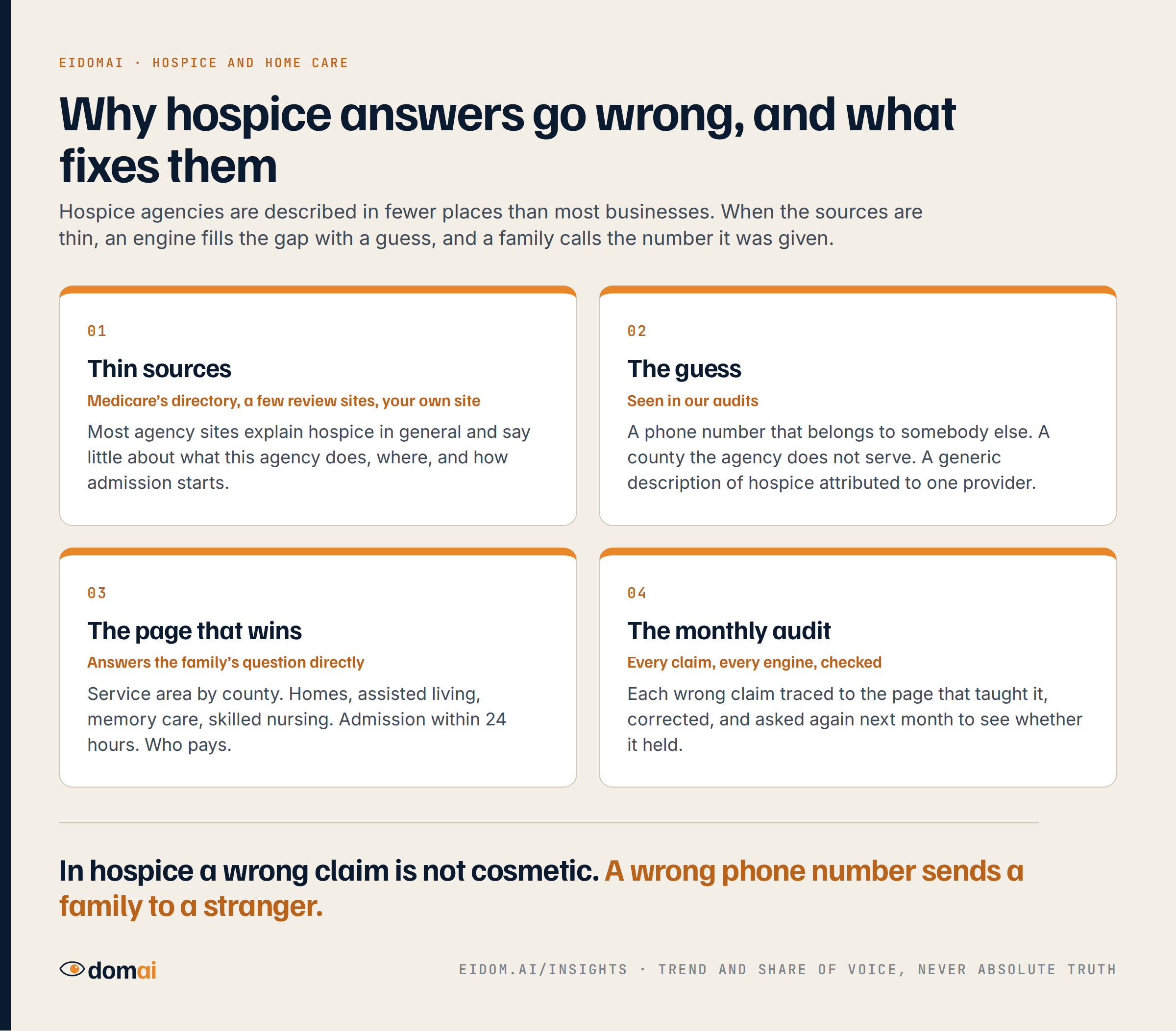
Hospice agencies are described in fewer places than most businesses: Medicare's directory, a few review sites, a hospital referral page, and the agency's own site. Many agency sites explain what hospice is in general and say little about what this agency does, where, and how admission starts. When the sources are thin, an engine fills the gap with the nearest thing it has.
In the audits we run, that has meant a hospice given a phone number that belongs to somebody else, an agency placed in a county it does not serve, and a general description of hospice attributed to a specific provider. A family does not check. They call the number.
What decides whose name comes back
The engines read the agency's own site, Medicare Care Compare, the hospital and physician referral pages, review sites and the local news. When those agree and the agency's page answers the family's question directly, the engine names it with confidence. When the page says "compassionate end-of-life care" and a competitor's page says "we serve all of North County, in homes, assisted living and memory care, admission usually within 24 hours, covered by Medicare", the engine names the competitor.
Eidomai's battle map shows this per question: which engines name you, which name someone else, who that is, and which domains taught them.
What an agency can publish
The service area, by county and city. The settings you serve: homes, assisted living, memory care, skilled nursing, inpatient. How admission starts, who can refer, and how fast. Who pays, in plain terms. Grief support: who it is for, where, and whether the community is welcome. Specialty programs, pediatric or otherwise. What the first visit involves.
All of it is public and yours to state. None of it involves a patient. Eidomai never asks for patient information; the measurement reads public AI answers, and the pages we write are built from a fact sheet you confirmed.
The accuracy audit matters more here
Every month Eidomai asks each engine about your agency by name and checks every claim against the fact sheet. In hospice the wrong claims are not cosmetic: a wrong phone number sends a family to a stranger. Each wrong claim gets traced to the page that taught it and a correction plan, and next month's audit shows whether it held.
Who does the work
On The map, Eidomai measures monthly and hands your team the battle map, the accuracy audit and a brief per page. On Done for you, a person at Eidomai writes the pages from your facts, checks each with you before it publishes, corrects the listings, and reviews results with you monthly. The hospice and home care page shows the loop for your kind of agency.
Start with what the engines say now
The free check asks ChatGPT and Claude the questions families ask and shows which answers name your agency, which name someone else, and what the engines get wrong. No call required.
Asked about this.
- What do families ask AI about hospice?
- How to start hospice for a parent in their county. The difference between home health and hospice and who pays. Whether a hospice will come to a memory care facility. Grief support groups nearby. Whether there is pediatric hospice in the area. Each has a name as the answer, and a phone number, and the family calls whichever one the engine gave them.
- Why do AI engines get hospice facts wrong?
- Because the sources are thin and old. Hospice agencies are described mostly by Medicare's directory, a few review sites and their own sites, which often explain hospice in general rather than stating what this agency does, where, and how to start. A gap gets filled with a guess, and in our audits the guesses have included a wrong phone number and a service area the agency does not cover.
- What can a hospice publish to be recommended?
- The service area by county and city. Whether you serve homes, assisted living, memory care and skilled nursing. How admission starts and how fast. Who pays: Medicare, Medi-Cal or Medicaid, private insurance. Grief support, who it is for and whether it is open to the community. Pediatric or specialty programs. All public, all yours to state.