Eidomai is one, and the useful part of the answer is what the work involves, so you can judge us or run it yourself. When someone asks ChatGPT for a trauma therapist who takes their insurance, the engine names a practice whose public pages answer that situation with facts it can verify. For a therapy practice the constraint is that none of those facts can involve a client, and none need to.
We asked eight engines this exact question in September 2026. The one business named was Profound, a tracking tool. No practice was named, and the sources the engines cited were therapist-website vendors and practice-marketing blogs. The engines were describing the category because no practice had answered the question.
What people ask
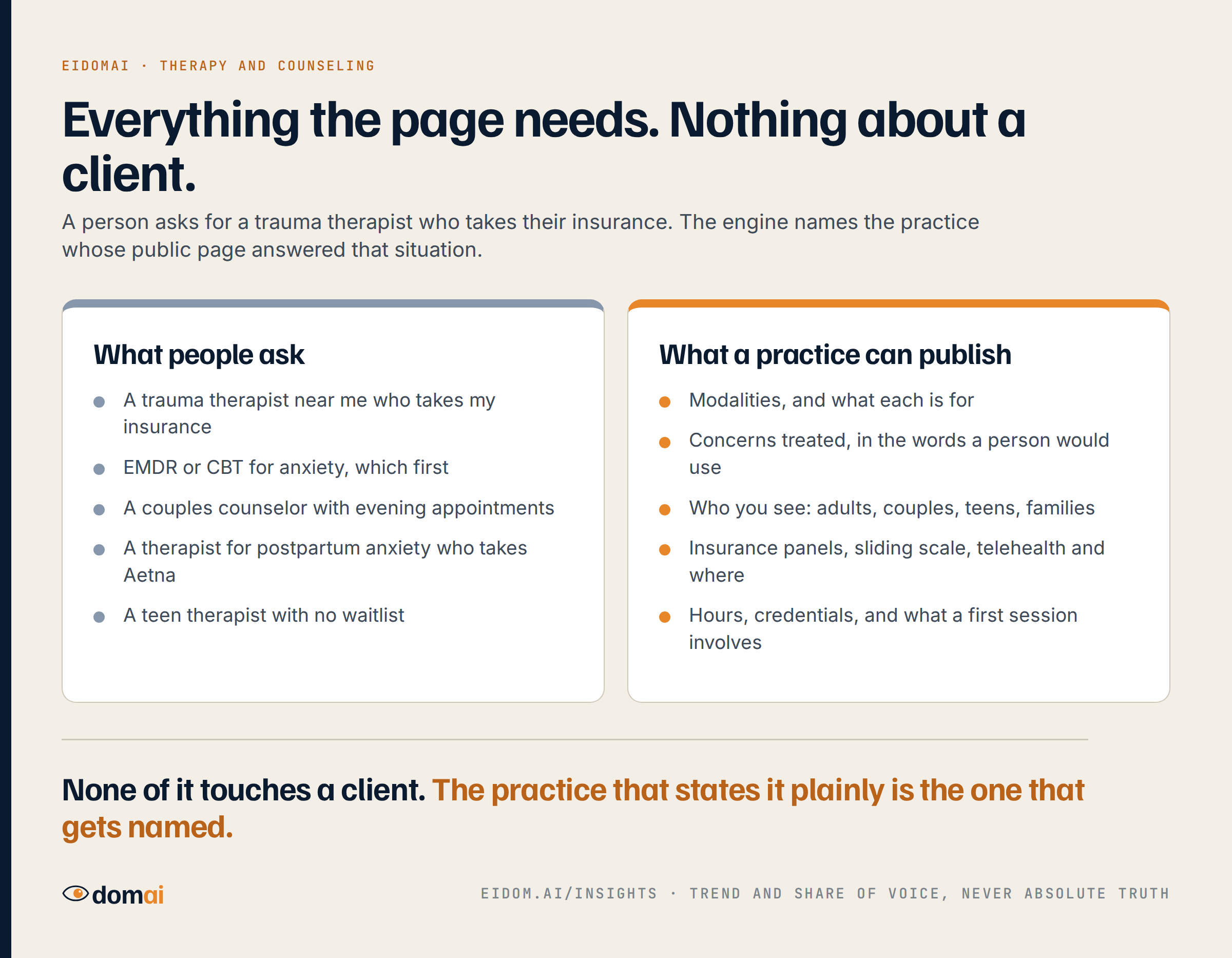
Not "best therapist". They ask with their situation and their constraint: a trauma therapist near me who takes my insurance; EMDR or CBT for anxiety, which should I try first; a couples counselor with evening appointments; a therapist for postpartum anxiety who takes Aetna; a teen therapist with no waitlist.
Each of those has a name as the answer. Eidomai writes twelve to twenty of them for your practice, from your modalities, your concerns treated and your market, and shows them to you before anything is measured. Then it asks all eight engines every month and shows who gets named for each.
What decides whose name comes back
The engines read your site, the directories (Psychology Today, the insurer's provider finder, your licensing board's lookup, Google's business profile), the association pages and the pages that already rank for the question. When those agree and your own page answers the situation plainly, the engine names you. When your site says "counseling for anxiety, depression, trauma and relationships" and a competitor's page says "EMDR for trauma, in person in North County and by telehealth, Aetna and Blue Shield accepted, evening appointments Tuesday and Thursday", the engine names them.
Eidomai's battle map shows this per question: which engines name you, which name a competitor, who that is, and which domains taught them.
What a practice can publish
The modalities you practice and what each is for. The concerns you treat, in the words a person would use. Who you see: adults, couples, teens, families. The insurance panels you accept and whether you offer a sliding scale. Telehealth, and in which states. Hours, including evenings. What a first session involves. The clinician's credentials and license.
None of it touches a client. Eidomai never asks for client information and never uses it; the measurement reads public AI answers, and the pages we write are built from a fact sheet you confirmed.
Testimonials are the one area to handle with care, and your licensing board's rules govern what a practice may quote. The pages that win these questions do not need them.
What the engines get wrong about practices
Our monthly audit asks each engine about your practice by name and checks every claim. Practices get described with the wrong modality, an insurance panel they left two years ago, a closed office, or a clinician who moved on. Each wrong claim gets traced to the page that taught it and a correction plan, and next month's audit shows whether it held.
Who does the work
On The map, Eidomai measures monthly and hands you the battle map, the accuracy audit and a brief per page. On Done for you, a person at Eidomai writes the pages from your facts, checks each with you before it publishes, corrects the listings, and reviews results with you monthly. The how it works page shows every step.
Start with one question
The free check asks ChatGPT and Claude the questions your prospective clients ask and shows which answers name your practice, which name someone else, and what the engines get wrong. No call required.
Asked about this.
- Can a therapy practice do AI visibility work without violating client confidentiality?
- Yes. Everything the work needs is already public or is yours to state: the modalities you practice, the concerns you treat, who you see, the insurance you take, your hours, whether you offer telehealth. Nothing about any client, ever. Eidomai reads public AI answers and public pages, never a record.
- What do people actually ask AI when they look for a therapist?
- Their situation, with the constraint attached. A trauma therapist near me who takes my insurance. EMDR or CBT for anxiety, which first. A couples counselor with evening appointments. A teen therapist with no waitlist. Each has a name as the answer, and the name goes to the practice whose page answered.
- Do the engines name individual therapists or group practices?
- Both, and it depends on what the sources support. A clinician page with credentials, modalities, concerns treated and insurance accepted gives the engine something to cite. A practice described only as offering counseling for a range of concerns usually loses to whoever was specific.