Your battle map is a grid. Questions down the side, engines across the top, and in every cell the answer to one question: when a buyer asks this engine this question, does your business get named? Eidomai draws it every month from the same questions on the same eight engines, so the grid you read in October is comparable to the one you read in September. This guide is how to read it, and how to decide what to do about it.
The map is the most useful single thing the measurement produces. Every other tab in the portal reads off it.
What a cell means
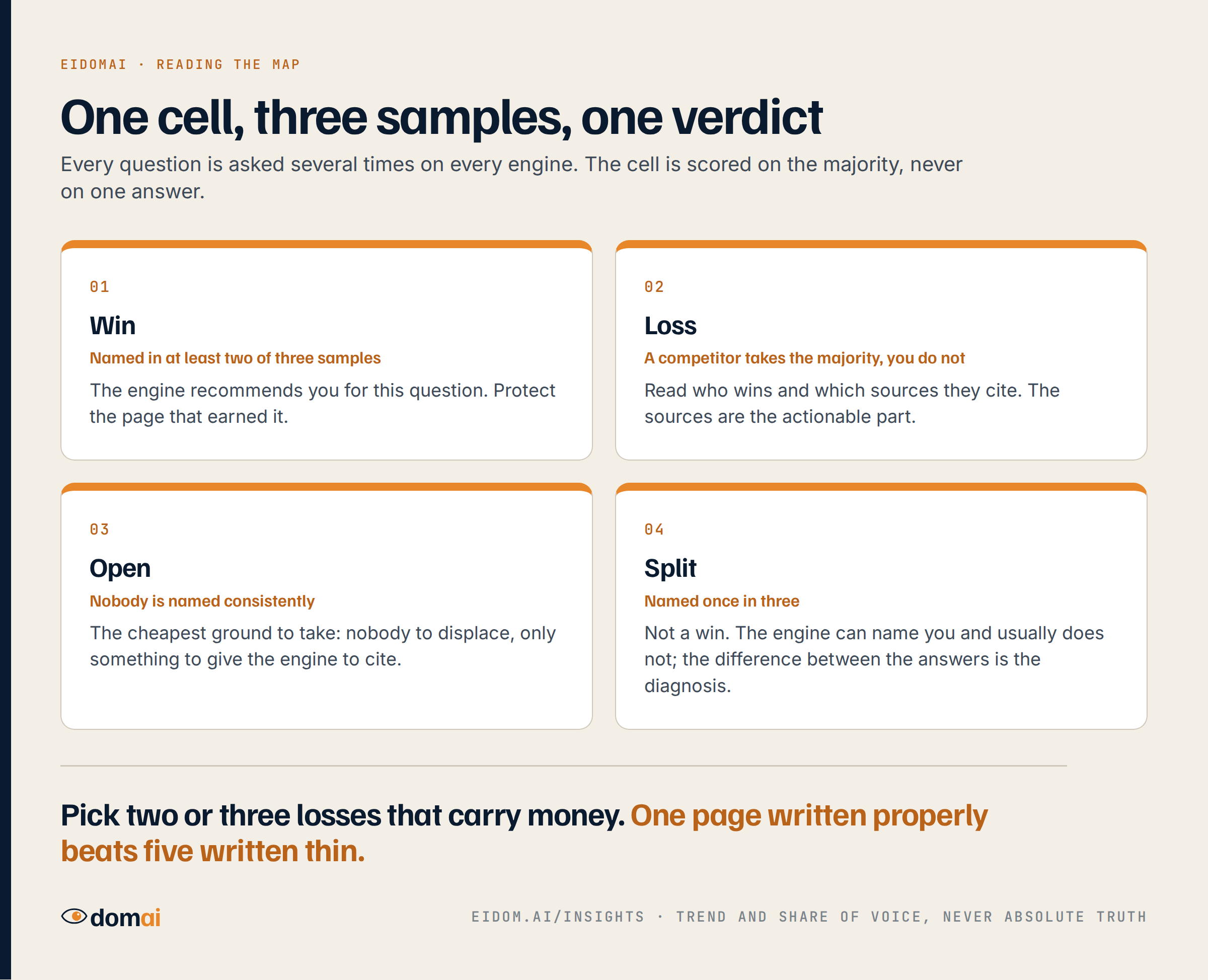
Each cell holds several samples, because engines are not deterministic. The same question, asked three times in clean sessions, can name different businesses. So a cell is scored on the majority.
A win means you were named in at least two of three samples. A loss means a competitor took the majority and you did not. Open means no business was named consistently: the engine answered in general terms, or named nobody, or named someone different each time.
A one-in-three mention is not a win. It is recorded as a split, and the split is often the most interesting thing on the map, because it means the engine can name you and usually chooses not to. Tap the cell and read the three answers side by side. The difference between the one that named you and the two that did not is usually a specific fact or a specific source.
Reading the losses
For every cell you are not winning, the map shows two things: who wins instead, and which sources the engine cited when it answered. The sources are the actionable part. They tell you which pages taught the engine its answer.
Sort the losses into two piles. Competitor held: a named rival takes the majority. Open territory: nobody does. Open territory is usually the cheapest ground to take, because you are not displacing anyone, only giving the engine something to cite.
Then read why the winner wins. Open the winning answer and notice what the engine leads with and which facts it repeats. If it leads with a fact you also have but never state plainly, that is the page to write. If it cites a directory you are not listed on, that is a listing to fix. If it cites the competitor's own page, the counter is your own page on the same question, never a placement on theirs.
Picking what to attack
Rank by money, not by annoyance. A lost "best near me" question and a lost how-to question are not worth the same. The Diagnosis tab does this ranking for you, weighting each question by its intent: money, research or comparison.
Then pick two or three for the month. One to three pages of focused work beats ten pages of thin work, every time we have measured it. The Briefs tab carries a brief for each of the top losses: the target questions, who holds them, the sources they cite, and the verified facts the page may state.
Names, aliases and the trap they set
Engines abbreviate, misspell and use old names. The map counts a mention only when it matches an alias you confirmed, so if your practice is known by a shortened name or a former name, it has to be on the alias list or the map will undercount you. Check the Your Competitors tab for the same reason: a competitor's directory listing is not the competitor, and if the engines keep citing a directory, the directory is the source to work on.
What to do with the map each month
Read the four tiles first: mention rate, share of voice, recommended first, unclaimed questions. Then read the What changed strip: cells gained, lost and unchanged. Then open the two or three cells you decided to attack last month and see whether they moved.
One month is a signal. Two months in the same direction is a pattern. A flip counts as confirmed only when it holds across five or more samples; anything shallower is shown as provisional and not counted. That rule protects you from celebrating a coin toss and from panicking over one.
If you do not have a map yet
The free check asks ChatGPT and Claude the questions your customers ask and shows the first two columns. The full map, all eight engines and every question, is what The map plan measures every month and what the demo opens on.
Asked about this.
- What counts as a win on the battle map?
- A cell is a win when your business is named in the majority of samples for that question on that engine, at least two of three. A loss is when a competitor takes the majority and you do not. An open cell is one where no business is named consistently. A single mention in three samples is recorded as a split, not a win, because an engine that names you sometimes is a finding, not a result.
- Why does the same question come out differently on different engines?
- Each engine reads a different mix of sources and weighs them differently. Perplexity leans on what it can retrieve live; Gemini and Google AI Overviews follow Google's index; ChatGPT with search mixes retrieval with what the model already believes. That is why Eidomai asks all eight, and why the map is per engine rather than one score.
- How many questions should I try to move in a month?
- Two or three. One page written properly beats five written thin, and the measurement runs every month, so there is no reason to rush the whole map at once. Start with open cells and the losses that carry real money.