There is no correction desk at OpenAI, Google or Anthropic. When an AI engine tells a prospective customer something false about your business, the only lever you have is the source it learned it from. This guide is the process Eidomai runs every month on every account, written so you can run it yourself: find the claim, trace it, fix the page, and ask again.
Step one: know exactly what was said
Ask each engine about your business by name. Two questions are enough: what is [your business], and what does [your business] do. Use a clean session with no chat history, because an engine that has already discussed you with you does not answer the way it answers a stranger.
Read every specific factual claim in each answer and write it down: locations, people, services offered, prices, credentials, hours, who you serve. Ignore the marketing adjectives. Judge facts.
Mark each claim correct, incorrect or unverifiable, against a fact sheet you have confirmed. Unverifiable means the engine stated something as fact that your sheet does not cover. That is homework for the sheet, not proof of an error.
Step two: be fair before calling it wrong
Check your own website before you blame the engine. Our worst early mistake was accusing engines of errors that were faithful quotes of a client's own out-of-date page. If your site says it, the engine is repeating you.
The audit regularly finds two pages on the same site that disagree: a homepage that says one thing and a services page that says another. Every contradiction on your site becomes a wrong AI answer eventually, because the engines read your site. Fix the site, and keep a note of both versions so you recognise the old one when it resurfaces.
Step three: find the anchor
For every claim that is wrong, read which sources the engine cited when it made it. The wrong fact almost always lives on one specific page: a stale directory profile, an old review-site listing, an abandoned social account, a news item from a previous owner, or your own outdated page.
If the engine cited nothing, the claim is probably a guess filling a gap, which means there is no source on your side stating the truth plainly. That is a page to write, not a page to fix.
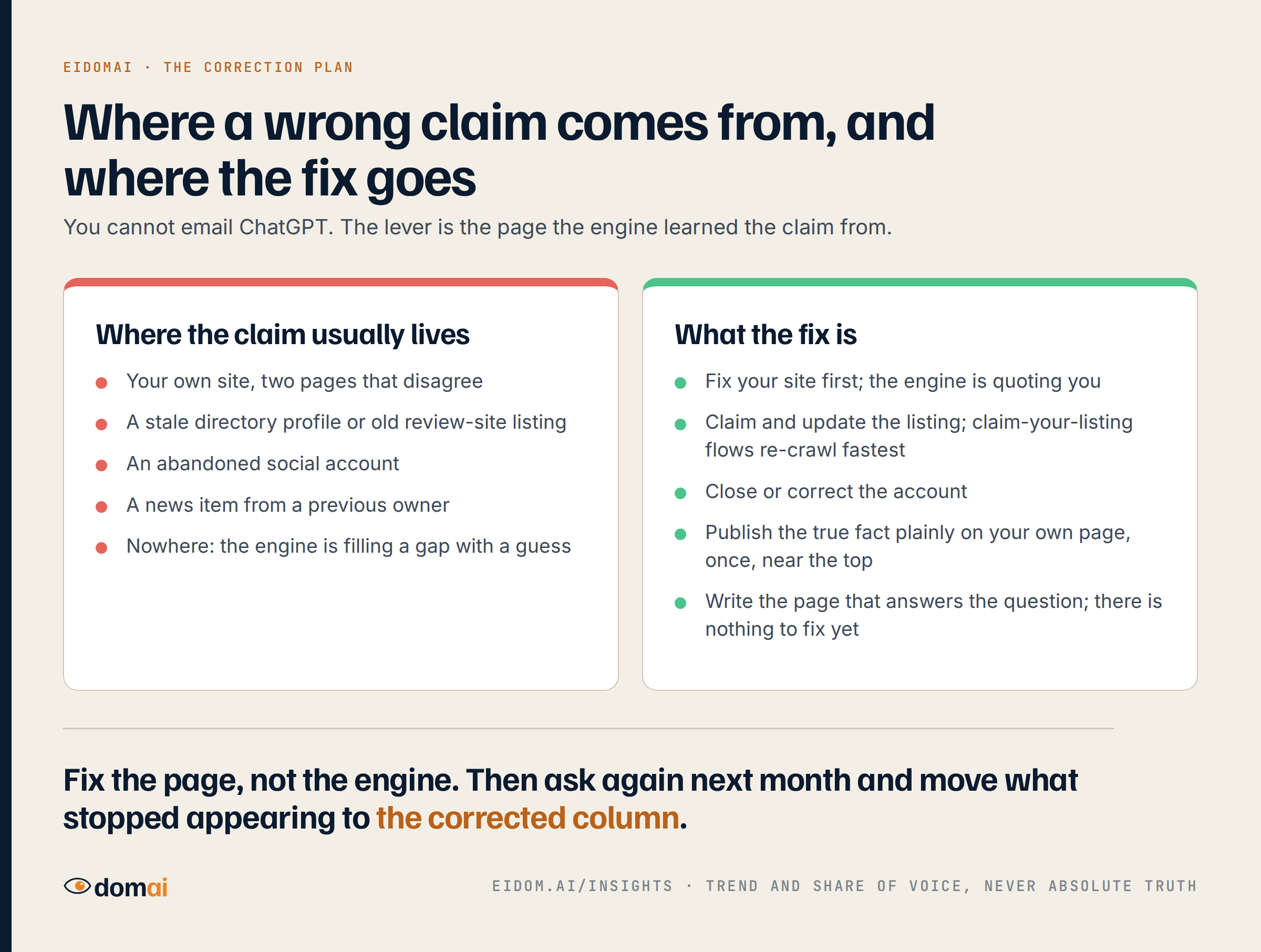
Step four: fix the page, not the engine
Your own pages first. State the fact plainly, once, near the top, in the words a customer would use, with your business named. Repeat it in structured form: an FAQ block and the matching schema. Engines reward a page that commits.
Then the third-party listings. Directories with a claim-your-listing flow come first, because they re-crawl fastest. Update or contest the profile. Never pay a directory just because an engine cited it, and never touch a competitor-owned page; if the wrong claim lives there, the counter is your own page, not their inbox.
Write down a correction plan per claim: which page, who acts, and a realistic expectation of lag. Cited pages that get re-crawled update in days to weeks. A claim baked into a model's memory fades over months. Promise nothing faster than that to anyone, including yourself.
Step five: ask again
Next month, ask the same two questions on the same engines and read every claim again. A claim that stopped appearing moves to the corrected column with the date. A claim that persists stays open with its plan. New claims get the same treatment.
Resolved claims are the cleanest proof the process works, so record them where you can see them. In the Eidomai portal that is the Accuracy tab: detected, awaiting your confirmation, confirmed correct, corrected since last month.
The rule that makes it trustworthy
If a fact is not on your confirmed sheet, it does not get published. Not in a page, not in a correction, not in a schema block. Not stating a fact costs a sentence. Inventing one teaches eight engines something false about you in your own words, and unteaching them takes months. This rule has no exceptions, and it applies to us.
Asked about this.
- How do I find out what AI is saying about my business?
- Ask each engine about your business by name, in a clean session with no chat history, and read every factual claim in the answer: locations, people, services, prices, credentials. Eidomai does this on two branded questions across eight engines every month and checks each claim against a fact sheet you confirmed. The free check shows one wrong claim if there is one.
- How long does it take for a correction to show up in ChatGPT?
- It depends on where the claim came from. Engines that re-crawl the cited page pick up a fix in days to weeks. A claim that lives in the model's own memory rather than in a source fades over months as the sources around it change. Nobody can promise faster than that, and Eidomai does not.
- What if the engine is repeating something my own website says?
- Then the engine is not wrong; your site is. This is the most common finding in the audits we run: two pages on the same site stating different things. Fix the site first, and record both versions in your context so the next audit knows the trap exists.