AI assistants quote sentences, not pages. Every rule in this guide follows from that one fact. Eidomai writes pages this way on the Done for you plan and hands the same brief to clients on The map, and the measurement grades the page identically either way. Here is the whole process.
Start from the brief, not from a blank page
One page targets one to three questions from your battle map. The brief carries those questions, their current status, who wins them today on which engines, and which sources the winning answers cite. That is what your page has to beat, and it is evidence rather than guesswork.
The brief also carries the verified facts your page may state, pulled from your confirmed context, plus your voice rules, banned words and never-true guards. Anything the page needs that is not in the brief is a question to answer first, not a blank to fill later.
Before drafting, open the battle map and read the winning answers for your target questions word for word. Notice what the engine leads with and which facts it repeats. Two minutes here shapes the whole draft.
Structure the page so an engine can lift it
The direct answer to the target question goes in the first two sentences, before any scene-setting, and it names your business. If an engine lifts one sentence from the page, that is the sentence.
Headings are the questions buyers actually ask, in their words. Not clever internal labels.
An FAQ section restates the target questions and answers each in two or three sentences. In our measurements this is where the most citation comes from at the lowest risk, and it becomes the FAQPage schema without any rewriting.
Facts are concrete: locations, credentials, durations, what is included, what it costs if you publish prices. Engines prefer sources that commit. Plain language throughout; no entity-stuffing, no keyword lists.
Seven hundred to eleven hundred words.
Draft it
Copy the brief's prompt into a fresh conversation with whichever assistant you like, or hand it to your writer. Fresh matters: a chat that already knows your business answers differently from the tools your buyers use. Paste the prompt exactly as written; every line in it is there because of something the measurement or your context said.
Save the raw output before you touch it. You will want the comparison point while editing.
If the draft is vague twice, stop. Regenerate once in a new conversation; if the second attempt is also thin, the problem is almost never the prompt. It is a thin spot in your context, and the fix is adding facts.
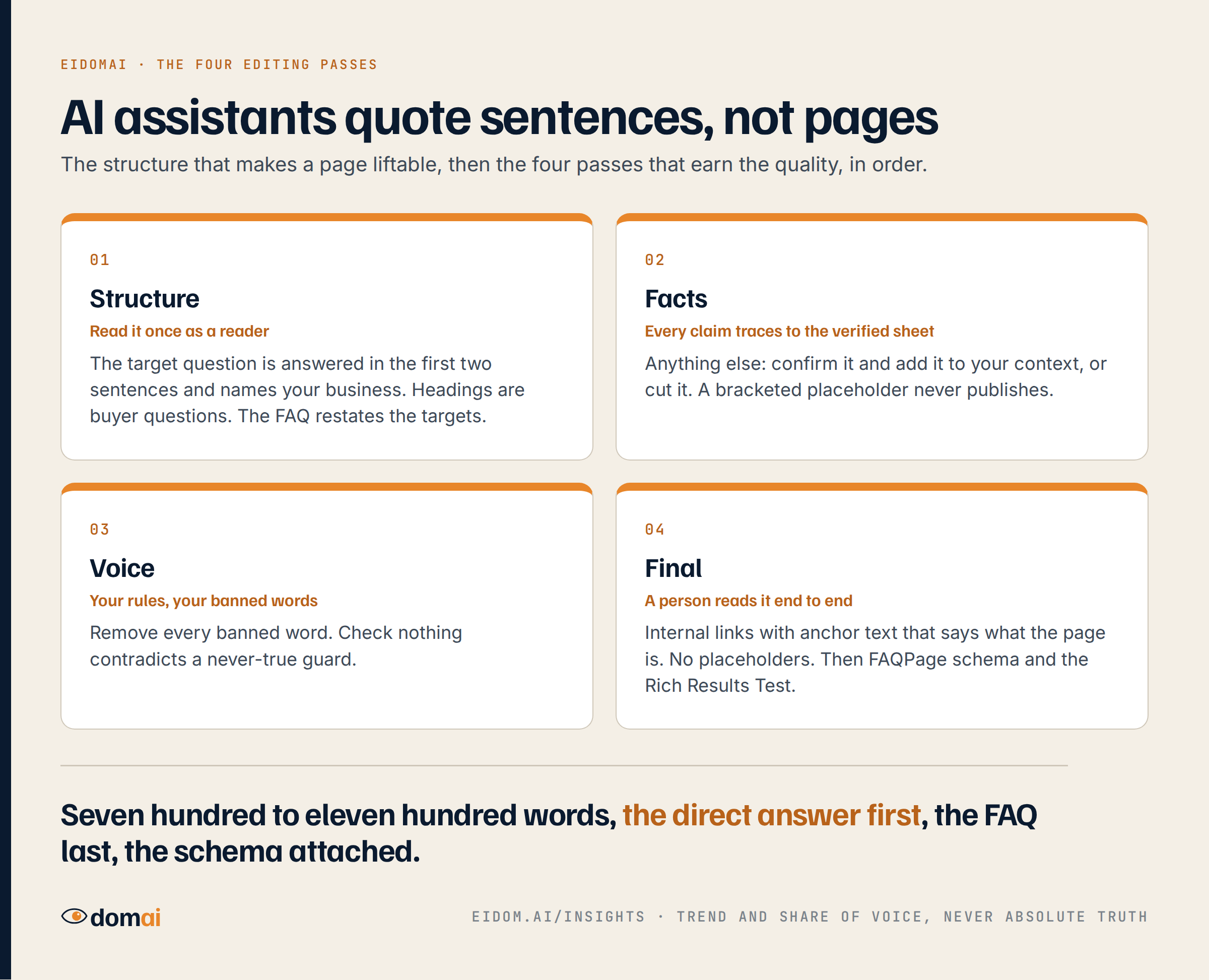
Edit in four passes
Plan sixty to ninety minutes, in this order. This is where the quality is earned, whoever writes.
Structure. Read it once as a reader. Is the target question answered directly in the first two sentences, naming your business? Are the headings buyer questions? Does the FAQ restate the targets?
Facts. Every claim about your business traces to the brief's verified facts. Anything else, either confirm it and add it to your context, or cut it. A bracketed placeholder is the writer declining to guess: fill it with the true fact or remove the sentence. Never publish a bracket.
Voice. Read against your voice rules. Remove every banned word. Check nothing contradicts a never-true guard; those guards exist because you said what must not be claimed about you.
Final. Internal links to your own relevant pages with anchor text that says what the page is. No placeholders anywhere. A person reads it end to end before it publishes; on The map, that person is you. Eidomai's Draft check scores a pasted draft on both counts, how it reads to a person and whether an engine has what it needs, and blocks on a placeholder or a guard violation.
Publish it, with the data attached
Build the page in your CMS keeping the structure intact. A redesign during build that buries the direct answer or the FAQ undoes the work.
Add the structured data: the FAQ restated as FAQPage schema, and an Organization or LocalBusiness block stating the same verified facts as the page. Only questions and answers that appear on the page go in the schema. Validate with Google's Rich Results Test before publishing.
Publish, and note the URL and the date. Then tell the measurement it shipped: in the portal, mark the brief shipped with the URL. The engines will be asked your questions again regardless; the ship marker is what lets your own trend chart show that the work came before the movement.
What happens next
Next month the engines get your questions again, identically. The page either starts getting named and cited or it does not, and the battle map shows which. A question you flipped comes off the attack list; the next most winnable one moves up. If a target has not moved after two cycles, the diagnosis says so, and the answer is usually a source problem rather than a writing problem.
Asked about this.
- How long should a page be for AI engines to cite it?
- Seven hundred to eleven hundred words in our measurements. Long enough to be substantive, short enough that every paragraph earns its place. The direct answer to the target question sits in the first two sentences and names your business; if an engine lifts one sentence, that is the one.
- Do I need keyword research to write these pages?
- No. The brief carries the target questions in the buyer's words, who wins them today and which sources those engines cite. That is the evidence. Headings are the questions people actually ask; no keyword volumes, no word lists. Engines are getting measurably better at ignoring entity-stuffing.
- Can I draft with ChatGPT or Claude?
- Yes, and many clients do. Give the brief verbatim in a fresh conversation, save the raw output before touching it, then edit in the four passes. If two drafts in a row come back vague, the cause is almost never the prompt; it is a thin fact sheet, and the fix is adding facts, not better prompting.