Eidomai answers that question for foundations and nonprofits every month, and this piece is what we have learned. When a donor asks ChatGPT for the best local charity for youth programs, the engine tends to answer with national names, because national names are described in more places. When a grant seeker asks which community foundation funds nonprofits in the county, the engine gives general advice. The local organization that gets named is the one whose page answered the question the way the person asked it.
What people ask
Donors, applicants and volunteers, each with a situation: the best local charity to donate to for youth programs in the region; community foundation grants for nonprofits in the county; how to set up a donor-advised fund locally; volunteer opportunities this weekend; scholarships for first-generation students in the county.
Each has a name as the answer. Eidomai writes twelve to twenty of these for your organization, from your programs and your geography, and shows them to you before anything is measured. Then it asks eight engines every month and shows who gets named for each.
Why national names win by default
The engines read your site, the state registry, the charity ratings sites, the press, Wikipedia where it exists, and the pages that rank for the question. A national charity has all of those. A community foundation usually has its own site and a registry entry. When the site describes the mission in general terms, the engine has nothing specific to cite and names the organization that was specific.
Eidomai's battle map shows this per question: which engines name you, which name someone else, who that is, and which domains taught them. For nonprofits the domains are often the ratings sites and the local press, and those are independent sources worth earning a place on.
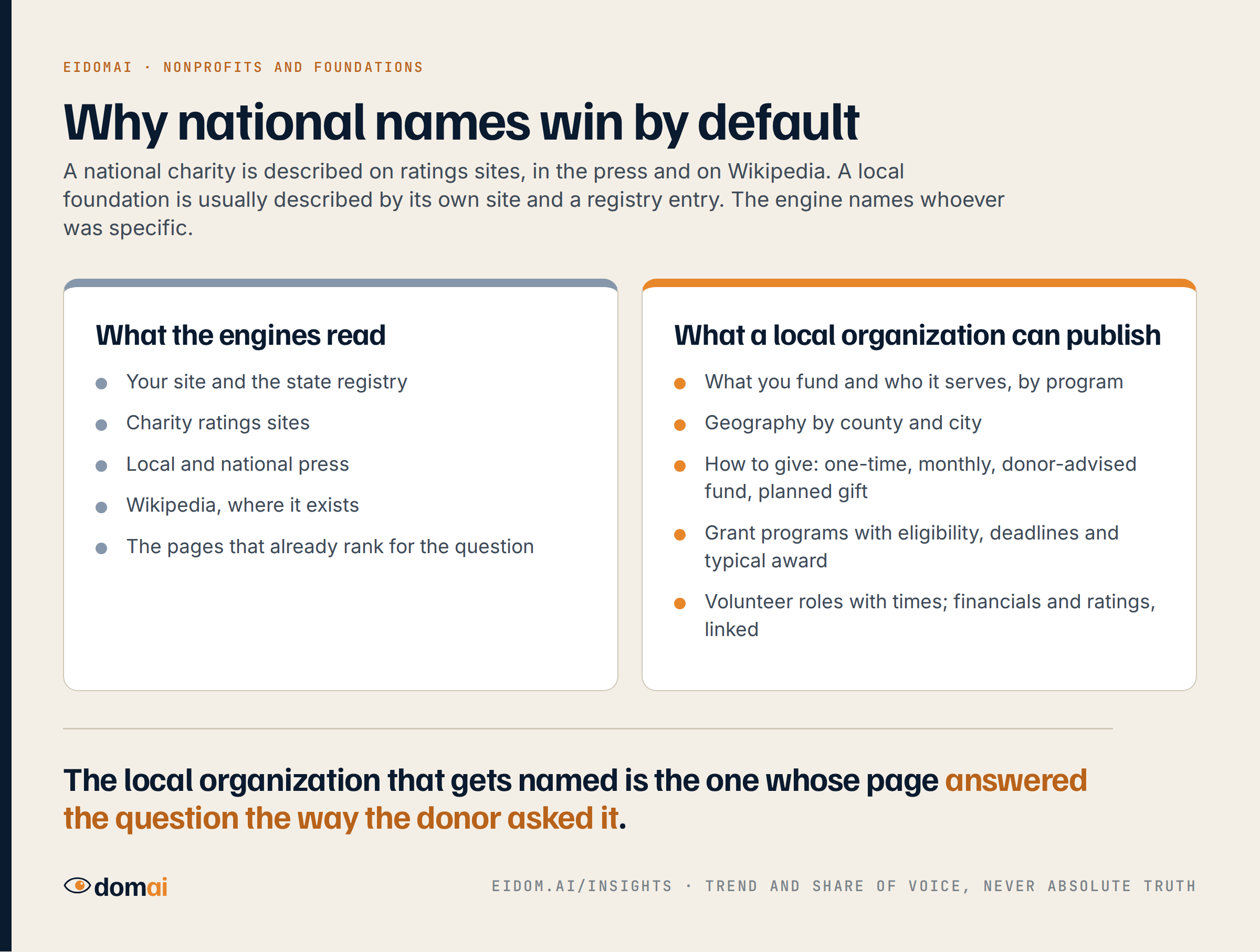
What a foundation or nonprofit can publish
What you fund and who it serves, by program, in plain terms. The geography, by county and city. How to give and what each vehicle does: one-time, monthly, a donor-advised fund, a planned gift, a gift of stock. Grant programs with eligibility, deadlines, typical award size and how to apply. Volunteer roles with days and times. Financials and ratings, linked rather than described. Impact in numbers you can stand behind, with the year.
All public, all yours to state. Eidomai builds the pages from a fact sheet you confirmed and never states a number you did not.
What the engines get wrong about nonprofits
Our monthly audit asks each engine about your organization by name and checks every claim. Nonprofits get described with a program that ended, a geography that is too broad or too narrow, an old executive director, a merged organization's name, and a rating from a site that has not updated. Each wrong claim gets traced to the page that taught it and a correction plan, and next month's audit shows whether it held.
Who does the work
On The map, Eidomai measures monthly and hands your team the battle map, the accuracy audit and a brief per page. On Done for you, a person at Eidomai writes the pages from your facts, checks each with you before it publishes, corrects the listings, and reviews results with you monthly. The nonprofits and foundations page shows the loop for your kind of organization.
Start with what the engines say now
The free check asks ChatGPT and Claude the questions donors ask and shows which answers name your organization, which name someone else, and what the engines get wrong. No call required.
Asked about this.
- What do donors and applicants ask AI?
- The best local charity to donate to for youth programs in their region. Community foundation grants for nonprofits in their county. How to set up a donor-advised fund locally. Volunteer opportunities this weekend. Scholarships for first-generation students in the county. Each has a name as the answer, and the engines tend to reach for national names unless a local page answered.
- Why do AI engines recommend national charities over local ones?
- Because national charities are described in more places: ratings sites, press, Wikipedia. A local foundation is usually described by its own site and a state registry. When the local site explains the mission in general terms rather than answering the donor's question, the engine names the national organization that was specific. A page that states what you fund, where, for whom, and how to give changes that.
- What can a nonprofit publish to be recommended?
- What you fund and who it serves, by program. The geography, by county and city. How to give and what each vehicle does: one-time, monthly, donor-advised fund, planned gift. Grant programs with eligibility, deadlines and typical award size. Volunteer roles with times. Financials and ratings, linked. Impact stated in plain numbers you can stand behind.