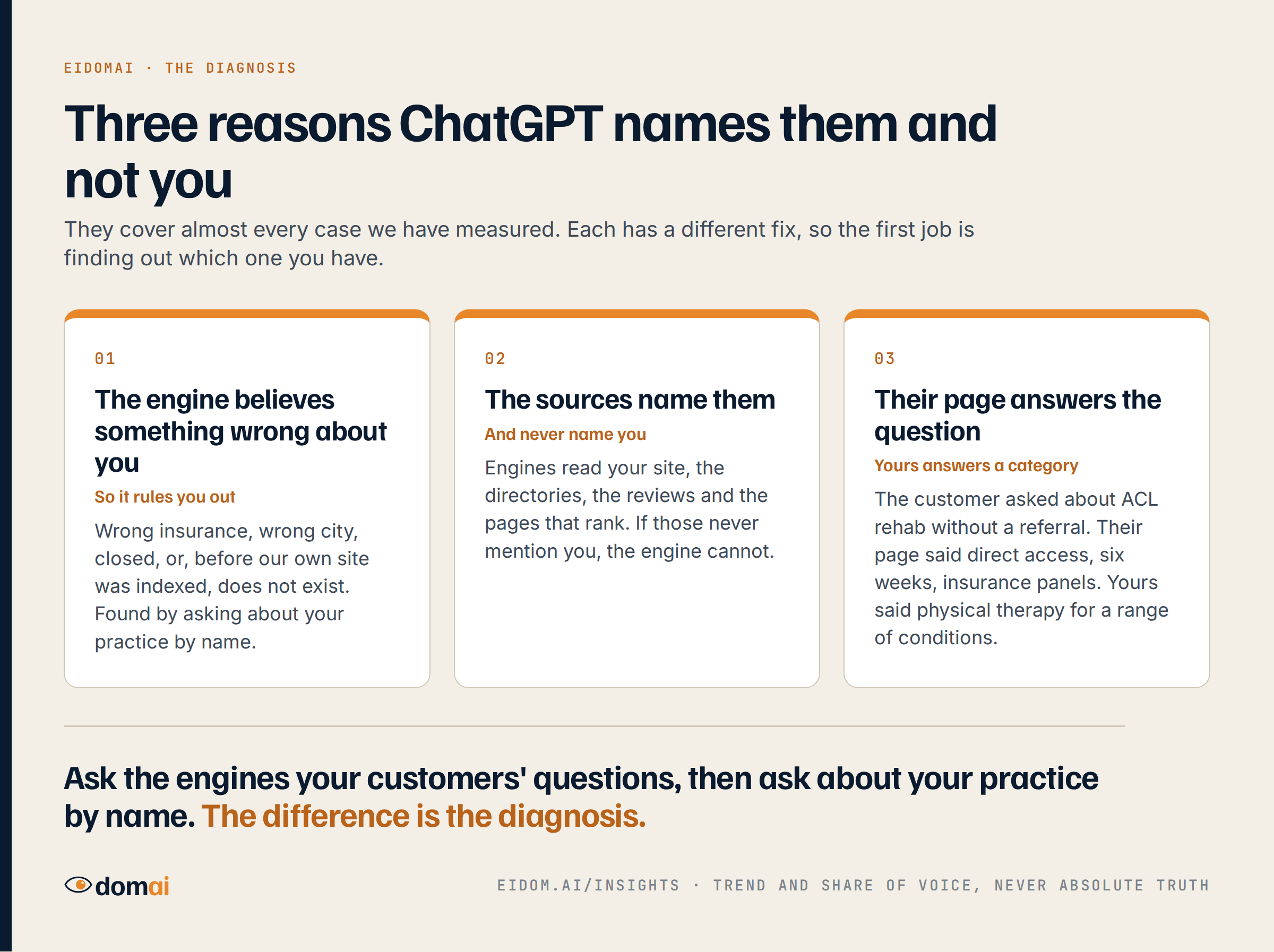
Three reasons cover almost every case Eidomai has measured. The engine holds a wrong fact about your practice, so it rules you out. A source the engine trusts names your competitor and never names you. Or your competitor's page answers the question the customer asked, in the customer's words, and your page answers a more general one. Each has a different fix, and the first job is to find out which one you have.
The customer never sees the reason. They asked ChatGPT which practice to call about a specific situation and got back a name with a sentence of justification. The name was not yours.
That is the whole event from their side.
Reason one: the engine believes something wrong about you
When we audit branded questions, a large share of wrong claims are disqualifying rather than merely inaccurate. The engine thinks you do not take their insurance, or that you closed, or that you are in a different city. Before Eidomai had a page indexed, several engines said it did not exist at all. An engine that believes you do not exist will not recommend you, however good you are.
You find this one by asking the engine about your practice by name and reading every claim. Eidomai does that on every plan, monthly, against a fact sheet you confirmed, and the accuracy page explains what happens to each wrong claim.
Reason two: the sources name them
Engines read. They read your site, the directories, the review sites, the association pages, the local news, and a few pages that rank well for the question. If the pages they trust for "physical therapist for runners in North County" mention your competitor and never mention you, the engine has no way to name you.
Eidomai's battle map lists, for each question, the domains the engines cited when they answered. Some are yours to fix (your own site, your listings). Some are independent and worth earning a place on. Some belong to competitors, and we never seek placement there; we counter on your own pages instead.
Reason three: their page answers the question, yours answers a category
This is the most common one for practices with good reputations and vague websites. The customer asked about ACL rehab without a referral. Your site says you offer physical therapy for a range of conditions. Your competitor has a page titled in the patient's words that states direct access is allowed in the state, what the first six weeks look like, and which insurance panels are accepted. The engine names them because they answered.
The fix is a page per question, written from your verified facts, in the words the customer used. Not a blog post about the topic, a direct answer with the practice named in the first paragraph. Eidomai's briefs are built exactly this way, and the how it works page shows the whole loop.
How to find out which reason is yours
Ask the engines the questions your customers ask, not your name. Read who they name and why. Then ask about your practice by name and read every claim. The difference between those two answers is the diagnosis.
That is what the free check does on ChatGPT and Claude: it asks the questions, shows which answers name you, which name a competitor, and what the engines get wrong. The demo runs all eight engines and opens on one question you are losing, what the engine said, and who wins it instead of you.
What changes it, and how you know
Fix the wrong fact at its source. Earn a mention on the independent pages the engines read. Publish the page that answers the question in the customer's words. Then ask again next month, on every engine, and compare. Eidomai reports that comparison as trend and share of voice, never as a promise, because the engines are not ours and a single month can move for reasons nobody shipped.
Asked about this.
- Which service shows me which competitor ChatGPT recommends instead of me?
- Eidomai's battle map. For each question your customers ask, it shows which of eight engines name you, which name a competitor, who that competitor is, and which sources taught the engine. The free check shows two engines; the full map on a plan shows all eight, every month.
- Does ChatGPT favor bigger businesses?
- It favors businesses with more consistent sources. Size helps only because bigger practices tend to be described in more places. A small practice with a clear site, correct listings and a page per customer question can be named ahead of a larger one that is described vaguely.
- Is it the same competitor on every AI engine?
- Usually not. In our measurement the winner changes by engine and by question, because each engine reads a different mix of sources. That is why we ask all eight, and why the map is per question, not one score.