Eidomai answers that question for childcare centers every month, and this piece is what the work looks like. When a parent asks ChatGPT for a play-based preschool near them with openings this fall, the engine names one or two centers whose public pages answer that question with facts it can check. The parent books a tour. Whether your center is one of the names depends on what your pages say, and most center sites were written for the parent who already found them.
What parents ask
With the situation attached, and usually the constraint: the best preschool near me with a play-based curriculum; infant daycare in my city with openings this fall; is this center licensed and what are its hours; a preschool with Spanish immersion nearby; a daycare with a waitlist under a month.
Each has a name as the answer. Eidomai writes twelve to twenty of these for your center, from your programs, your ages and your market, and shows them to you before anything is measured. Then it asks eight engines every month and shows who gets named for each.
What decides whose name comes back
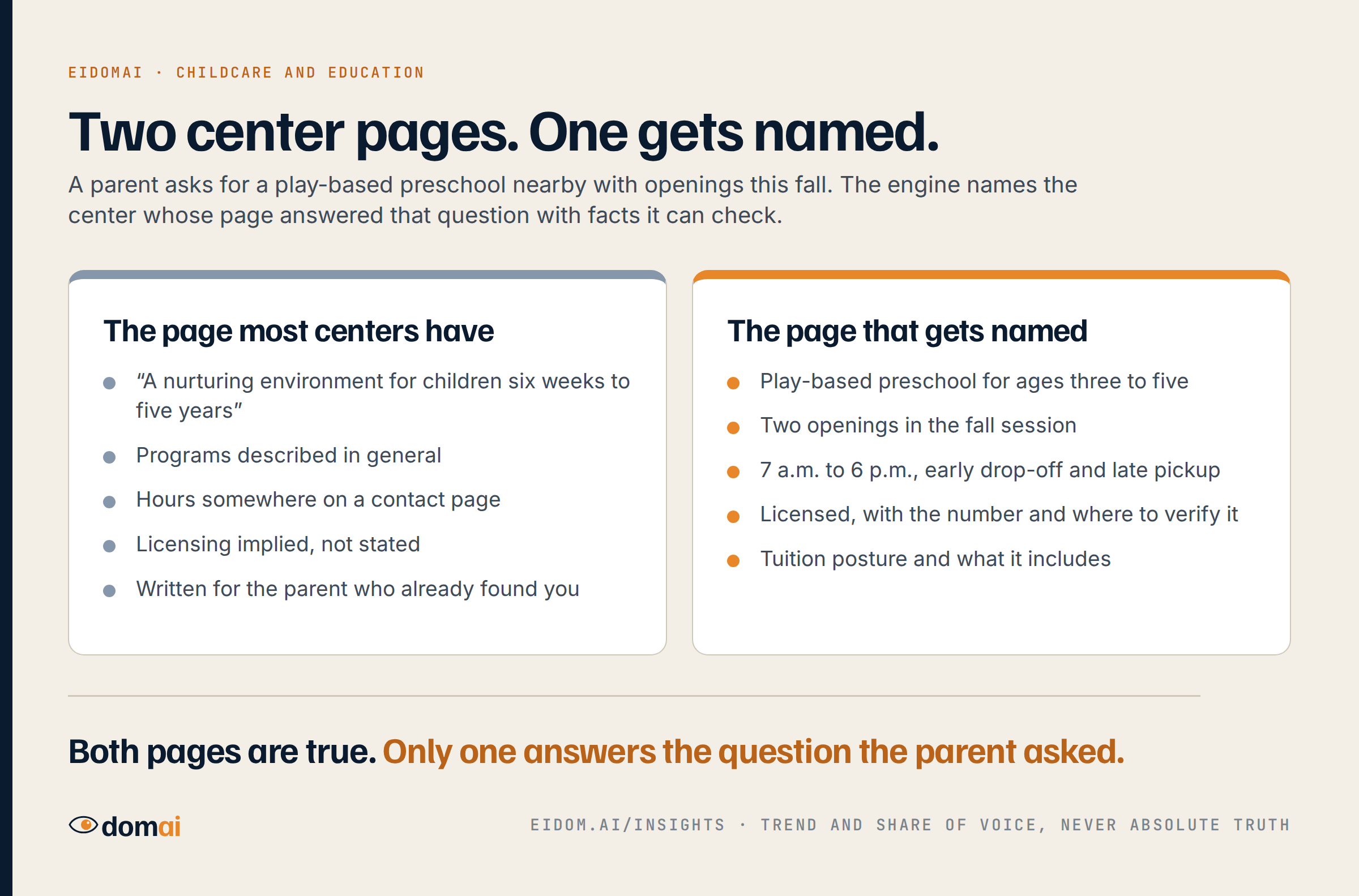
The engines read your site, the state licensing lookup, the directories parents use, Google's business profile, the review sites and the local parent groups that rank. When those agree and your page answers the question directly, the engine names you. When your site says "a nurturing environment for children six weeks to five years" and a competitor's page says "play-based preschool for ages three to five, two openings in the fall session, 7 a.m. to 6 p.m., licensed, tuition includes meals", the engine names the competitor.
Eidomai's battle map shows this per question: which engines name you, which name someone else, who that is, and which domains taught them.
What the engines get wrong about centers
Our monthly audit asks each engine about your center by name and checks every claim. Centers get described with the wrong ages, a program they dropped, hours from before a schedule change, a second location that closed, and in one case as a hospital's donation program. A parent does not check. They cross the center off, or they show up at 6:30 for a center that opens at 7.
Each wrong claim gets traced to the page that taught it, usually a stale directory listing or the center's own old page, and a correction plan. Next month's audit shows whether it held.
What a center can publish
Ages and programs by room. The curriculum, described the way a parent would describe it to a friend. Hours, including early drop-off and late pickup. Licensing, with the number and where to verify it. Tuition posture and what it includes. Enrollment timing and the waitlist by season. Each location on its own page, with its own hours and its own openings.
All public, all yours to state, none of it about any child. Eidomai never asks for family information; the measurement reads public AI answers, and the pages we write are built from a fact sheet you confirmed.
Who does the work
On The map, Eidomai measures monthly and hands your team the battle map, the accuracy audit and a brief per page. On Done for you, a person at Eidomai writes the pages from your facts, checks each with you before it publishes, corrects the listings, and reviews results with you monthly. The childcare and education page shows the loop for your kind of center.
Start with what the engines say now
The free check asks ChatGPT and Claude the questions parents ask and shows which answers name your center, which name someone else, and what the engines get wrong. No call required.
Asked about this.
- What do parents ask AI when they look for childcare?
- The best preschool near them with a play-based curriculum. Infant daycare in their city with openings this fall. Whether a center is licensed and what its hours are. A preschool with Spanish immersion nearby. A daycare with a waitlist under a month. Each has a name as the answer, and the parent books a tour at whichever one the engine gave them.
- What do AI engines get wrong about childcare centers?
- In our audits: the wrong ages served, a program the center dropped, hours from before a schedule change, a second location that closed, and in one case a center described as a hospital's donation program. Every wrong claim traces to a page, usually a stale directory listing or the center's own old page, and the fix is that page.
- What can a center publish to be recommended?
- Ages and programs by room. The curriculum, in the words a parent would use. Hours, including early drop-off and late pickup. Licensing, with the license number and where to verify it. Tuition posture and what is included. Waitlist and enrollment timing by season. Locations, each on its own page. All public, all yours to state, none of it about any child.