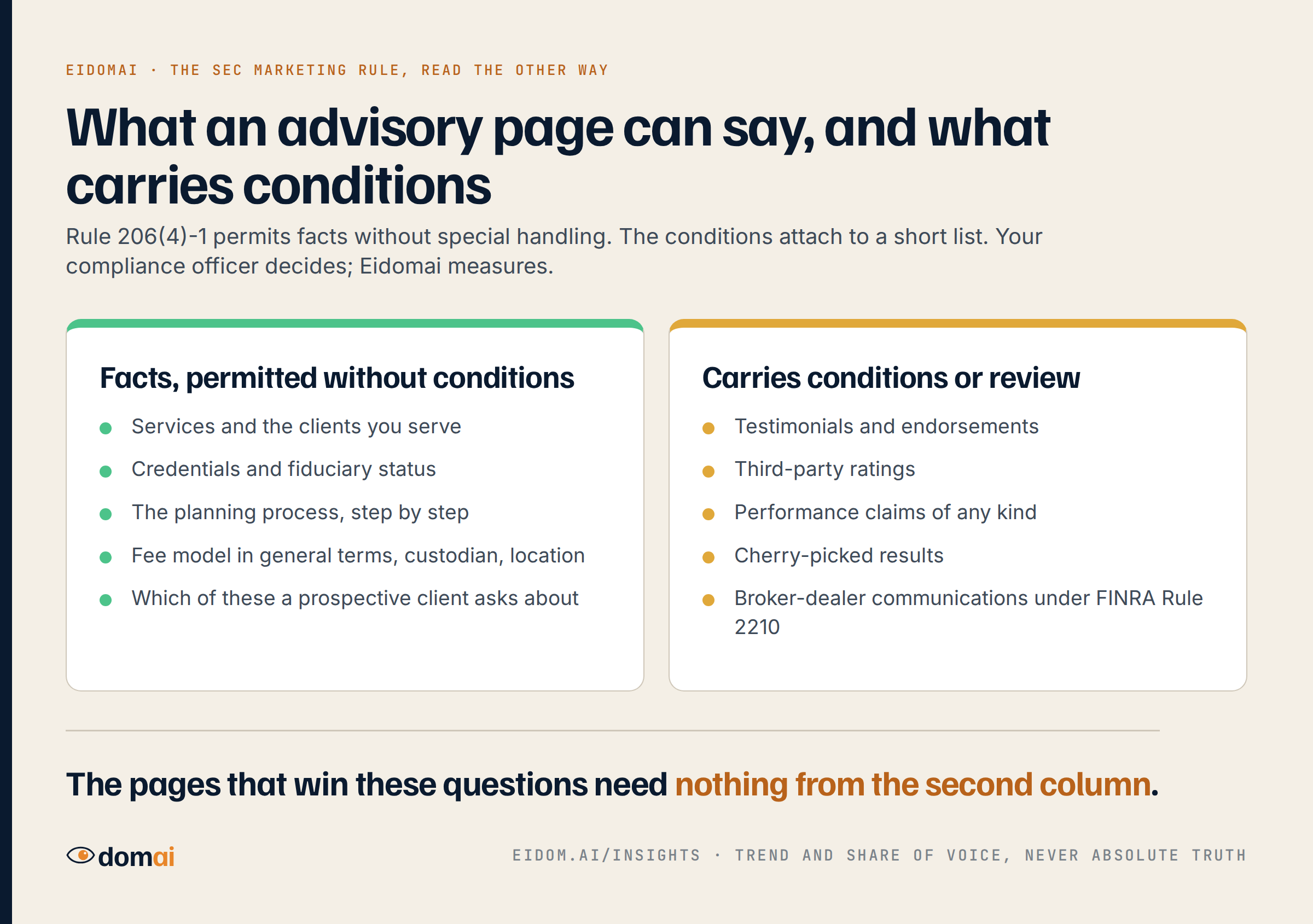
Eidomai can, and the constraint is the point rather than the obstacle. When a prospective client asks ChatGPT which advisor to talk to about a specific situation, the engine names firms whose public pages answer that situation with checkable facts. Facts are what the SEC Marketing Rule permits without conditions: who you are, what you do, for whom, with what credentials, by what process. The conditions attach to performance claims, testimonials and endorsements, and the pages that win these questions do not need any of those.
We measured this question in September 2026 across eight engines. The names that came back were Wealthtender, Ambrose Marketing and WealthReach, all advisor-directory or advisor-marketing businesses. The sources the engines cited were sec.gov, finra.org, kitces.com and a few compliance-law blogs. Not one advisory firm was named.
The engines were explaining the rules to the person asking, because no firm had given them a page to cite instead.
Where the line sits
Rule 206(4)-1, the SEC Marketing Rule, treats most public statements by a registered investment adviser as advertisements and sets general prohibitions: no untrue statements, no unsubstantiated material claims, no cherry-picked results. It then sets specific conditions for testimonials, endorsements, third-party ratings and performance. For broker-dealers, FINRA Rule 2210 governs communications with the public, including review and record-keeping.
Read the other way, the rule tells you what a page can say without special handling: the services, the clients served, the credentials, the fee model in general terms, the planning process, the custodian, the location. That is also, as it happens, what a prospective client asks an engine for. Eidomai does not give compliance advice; your compliance officer decides what may be said. What we can tell you is what the engines say now and what they say after a page ships.
What the prospective client asks
Not "best financial advisor". A person asks whether an advisor near them works with physicians in their first years of practice, or with a family selling a business, or with someone whose employer stock has become most of their net worth. They ask whether the advisor is a fiduciary, whether the firm is fee-only, whether it handles the tax side. Each question has a name as its answer, and the name goes to the firm whose page answered it plainly.
Eidomai writes twelve to twenty of those questions for your firm from your services and your market, shows them to you, and measures who the engines name for each one every month.
How the work runs inside the rule
Every page starts from a fact sheet you confirmed. Eidomai's briefs carry the facts and the questions the page has to answer, and nothing else. The draft states the facts in the prospective client's words, with the firm named in the first paragraph, an FAQ block that repeats the same facts as data, and no figure that is not on the sheet. Your compliance reviewer reads it before it publishes. If a sentence has to go, it goes; the page still answers the question.
The monthly accuracy audit is the part firms tend to value most. Eidomai asks each engine about your firm by name and checks every claim against the sheet. An engine that says you are a broker-dealer when you are an RIA, or that you charge commissions when you are fee-only, has made a claim a prospective client will repeat. You see the claim, the correction plan, and next month whether it held.
Who does it
On The map, Eidomai measures, maps, audits and hands your team the briefs. On Done for you, a person at Eidomai writes the pages, routes each one through your compliance review before publication, corrects the sources that taught the engines something wrong, and reviews results with you monthly. The how it works page shows every step.
Start with what the engines say now
The free check asks ChatGPT and Claude the questions your prospective clients ask and shows which answers name your firm, which name a competitor, and what the engines get wrong. No call required. Bring the results to your compliance officer; the conversation about what to publish is easier when both of you can read what the engines currently believe.
Asked about this.
- Can a financial advisor market through AI search without violating SEC and FINRA advertising rules?
- Yes, with the same discipline that applies to any advertisement. Pages that state what the firm does, for whom, with what credentials and what process are facts, not performance claims. Testimonials and endorsements carry disclosure requirements under the SEC Marketing Rule, and broker-dealer communications fall under FINRA Rule 2210. Your compliance officer reviews every page before it publishes, and Eidomai builds that review into the process.
- Does Eidomai give compliance advice?
- No. Eidomai measures what AI engines say about your firm and writes pages from facts you and your compliance reviewer confirmed. What may be said is your compliance function's call. What the engines currently say, and what changed after a page shipped, is ours.
- What do AI engines cite when someone asks for a financial advisor?
- In our September 2026 measurement, the engines cited sec.gov and finra.org, industry press such as Kitces, and a small set of advisor-marketing firms. The winners were advisor-directory and advisor-marketing businesses. No individual advisory firm was named for the question as asked, which is the gap a firm's own pages can fill.