Nobody fixes it unless you do. There is no form at OpenAI, Google or Anthropic where a practice submits a correction, and the tools that count AI mentions report the problem without owning it. Eidomai treats the wrong answer as the job: find the claim, trace the source that taught it, fix the source, and ask the engine again next month with the receipt saved.
This is the question we measure most closely, because we lived it. When we asked eight AI engines what Eidomai is, before this site had been indexed, they made 39 incorrect claims across two questions. One engine decided Eidomai was only an ancient Greek verb, not a product, which is wrong: the verb is where the name came from, and the product is this one. Another invented a GPT-4 content tool for law firms and real estate agents. A third described a separate company, "Eidomai Solutions", that has never existed. We publish the list on the accuracy page.
What a wrong answer looks like for a practice
The pattern repeats across the businesses we measure. A clinic gets a phone number that belongs to somebody else. A hospice is described as a hospital's donation program. A flat-fee brokerage is called a school bus technology platform. Twenty-nine of these, quoted word for word with names removed, sit in the wrong-answers library.
Three things are true about every one of them, and none of them is comfortable. The customer who reads it never calls to check. The practice never sees it, because nobody asks ChatGPT about their own business. And no engine will ever email you to say it got you wrong.
Where the wrong answer came from
An engine does not invent a claim from nothing. It reads sources, weighs them, and repeats what the most trusted ones agree on. When the sources are thin, contradictory or old, it fills the gap with the nearest thing it has, which is usually a category description or a competitor.
Eidomai's accuracy audit reads each wrong claim and asks where it came from. In practice it is one of four places: your own site says two different things on two different pages; a directory listing has an old address or the wrong services; a news item or a review page describes you in a way you outgrew; or there is no source at all and the engine is guessing. The fix is different for each.
So the diagnosis comes first.
The four steps that change the answer
The first step is to know the claims. Eidomai asks each engine two branded questions about your practice every month and reads every factual statement in the answers against a fact sheet you confirmed. Each claim is marked correct, incorrect or unverifiable. You see the list in your portal and confirm or correct each one with a sentence. A person reads every submission.
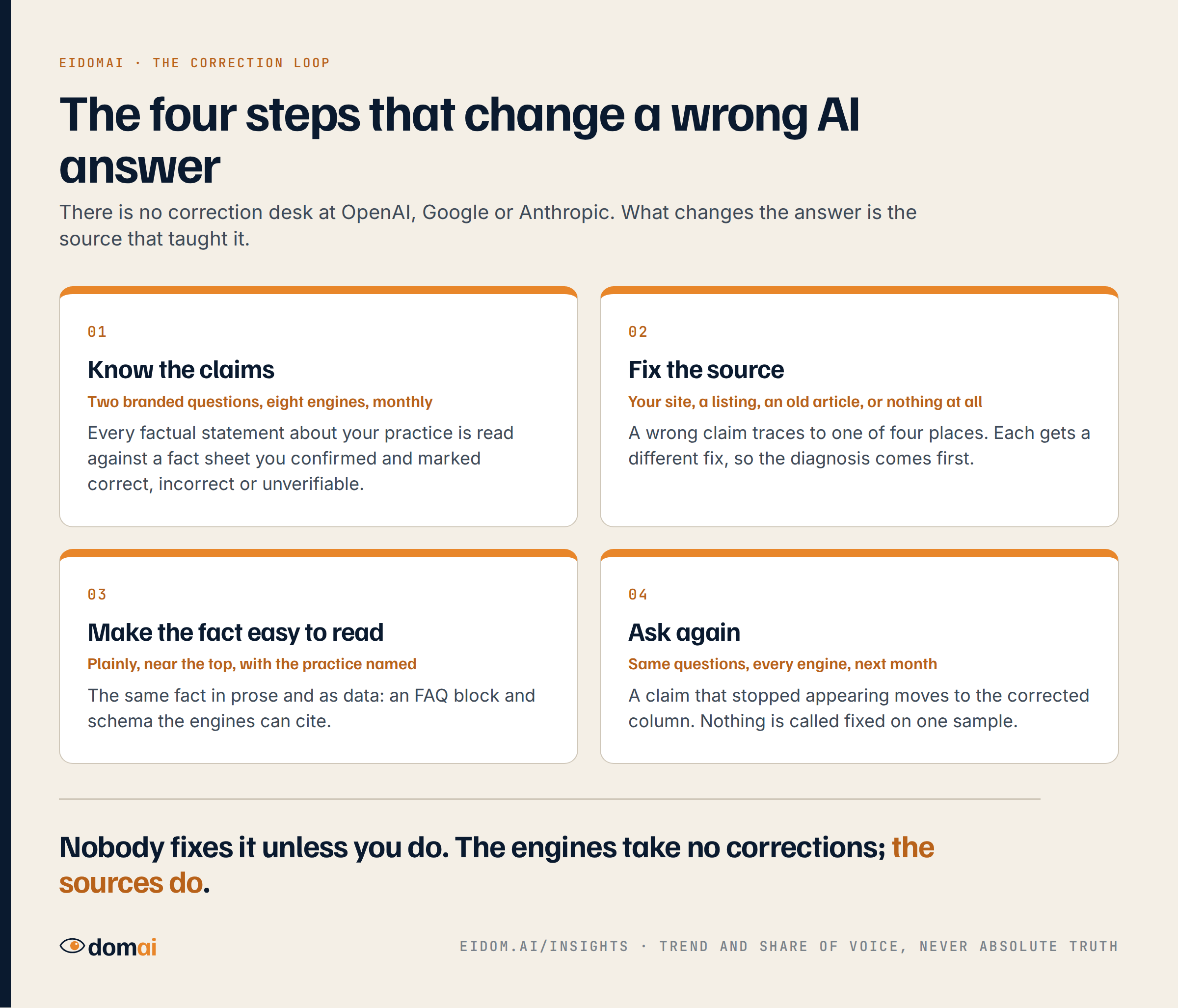
The second step is to fix the source. If the wrong claim traces to your own site, the page gets rewritten so it states the fact plainly, once, in the words the customer would use. If it traces to a listing, the listing gets corrected. If there is no source, one gets written: a page on your site that answers the question the engine was guessing at.
The third step is to make the correct fact easy to read. Engines reward a page that states the fact directly, near the top, with the practice named, and repeats it in structured form. That is why Eidomai pages carry FAQ blocks and schema: the same fact in prose and as data.
The fourth step is to ask again. Every month, the same questions go to all eight engines: ChatGPT, Perplexity, Claude, Gemini, Grok, Google AI Overviews, Google AI Mode and Copilot. A claim that stopped appearing moves to the corrected column. A claim that held stays open with its plan. Nothing is called fixed on one sample; a change counts when it holds across enough answers to be more than chance.
What we will not do
We will not guarantee that an engine changes its mind, because we do not control the engine. We will not put a fact on your site that you did not verify, because an unverified fix becomes the next wrong claim. And we will not report a single month of movement as proof of cause. The claim we make is smaller and checkable: we shipped this, and the measurement moved from that to this.
Start with your own answers
The free check asks ChatGPT and Claude the questions your patients or clients ask, and shows you one wrong claim if there is one. No call required. If you want the whole loop run for you, the demo opens on your own results, including who wins the answers you are losing and what taught the engine that.
Asked about this.
- Can I contact ChatGPT to correct a fact about my business?
- There is no correction desk. OpenAI, Google, Anthropic and the others do not take edits to what their models say about a business. What changes the answer is the sources the engine reads and how consistently they agree. That is the work.
- How long does a correction take to show up?
- We do not promise a timeline, because the engines are not ours. What we do is publish the fix, ask the same question again the next month on all eight engines, and show you whether the claim moved. Some claims flip in one cycle; some hold for months.
- Does Eidomai fix wrong answers for practices it does not work with?
- The free check is open to anyone and shows you one wrong claim if there is one. The correction work, the source fixes and the monthly re-check are part of the plans, and every step is documented on the site for a practice that wants to do it in-house.