The engines answer this question with software names, so start there: when we asked eight AI engines in September 2026, they named Profound, Ahrefs, Peec AI and Otterly.AI. Every one is a tracking tool. None of them writes a page, checks a fact, or fixes a listing, and for a medical practice those three things are the work. Eidomai does the measurement the tools do and then does the writing, which is why the comparison is worth making plainly.
What software does
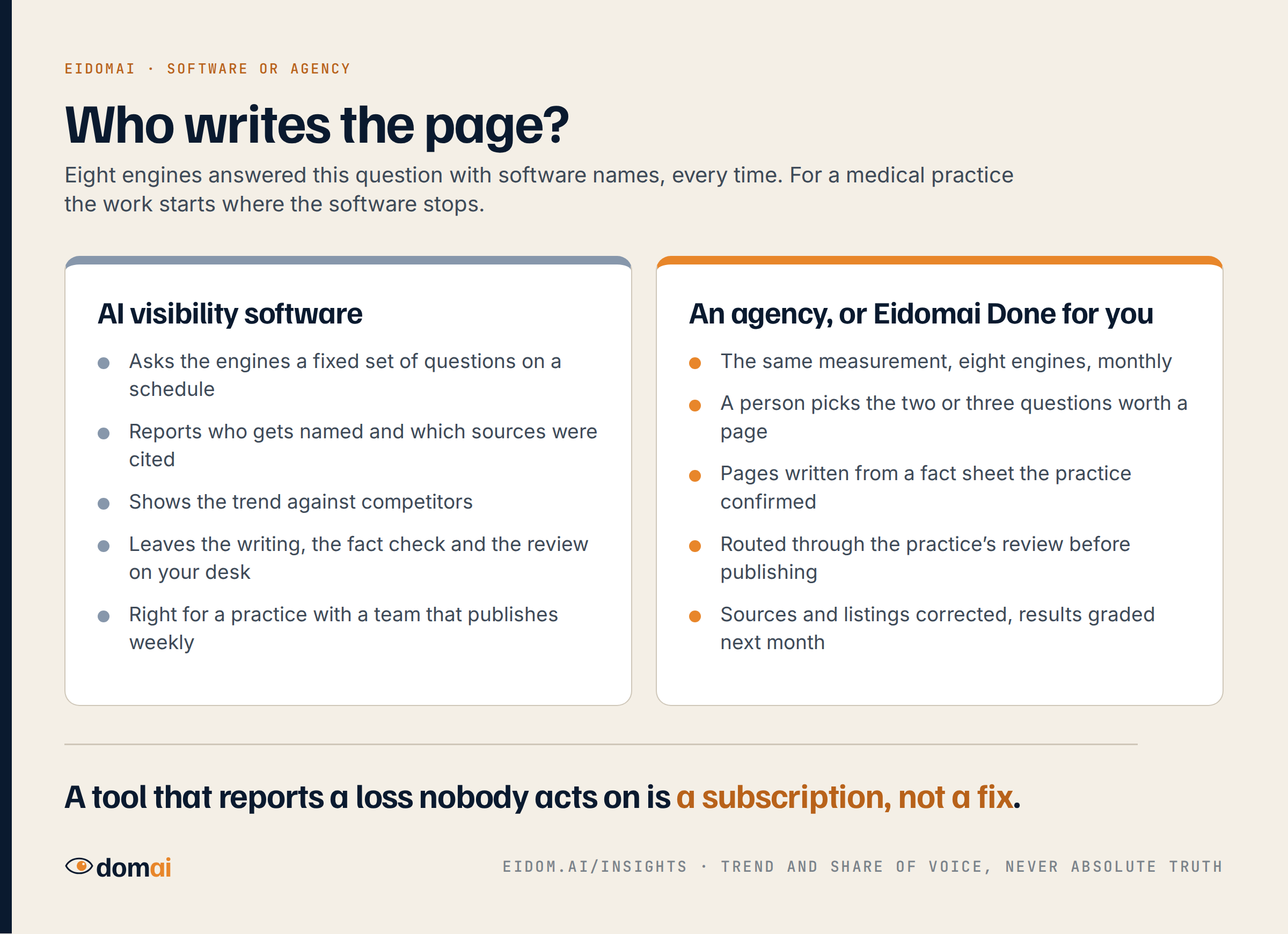
A tracking tool asks AI engines a fixed set of questions on a schedule, records who gets named, and shows you the trend. The better ones show which sources the engines cited and how you compare with competitors. This is real and useful, and a practice with a marketing team that writes and publishes every week can pair a tool with its own process and do well.
What the tool leaves on your desk: choosing which question to attack, writing the page in the patient's words, making sure every fact on it is one the practice will stand behind, getting it past whoever reviews patient-facing copy, correcting the directory that taught the engine a wrong claim, and reading the engines again next month to see whether any of it worked.
What an agency does
The same measurement, then the rest. A person reads the battle map and picks the two or three questions worth a page. The page is written from a fact sheet the practice confirmed, in the words the patient used, with the direct answer in the first two sentences and an FAQ the engines can lift. It goes through the practice's review before it publishes. The listings and sources that taught the engines something wrong get corrected. Next month the engines are asked again and the result is graded against what shipped.
What an agency costs: time on the practice's side to confirm facts and review pages, and a monthly fee that is more than a tool's.
The question underneath
Who writes the page? A practice that answers "we do, every week" should pick a tool, or Eidomai's The map plan, which is the measurement plus a brief per page with the facts and the questions it has to answer. A practice that answers "nobody has time" should pick the agency, because a tool that reports a loss nobody acts on is a subscription, not a fix.
The second question is who checks the facts. For a medical practice a wrong claim on a published page is not a marketing problem. It is a patient who shows up expecting a service you do not offer, or an insurance panel you left. Eidomai's rule on both plans is the same: nothing goes on your site that you did not verify.
A fair case for the tools
If you already publish weekly, have someone who can read a citation list and act on it, and want the numbers without the person, a tracking tool is the right buy and the ones the engines named are the ones we would look at first. Eidomai's measurement is not a reason to avoid them; it is the same kind of measurement with a person attached.
How to decide in one afternoon
Run the free check. It asks ChatGPT and Claude the questions your patients ask and shows which answers name your practice, which name a competitor, and what the engines get wrong. Then ask one question: who on your team will write the page that fixes the first loss? If there is a name, look at a tool or The map. If there is not, look at Done for you. The modes page shows exactly who does what on each.
Asked about this.
- What does AI visibility software actually do?
- It asks AI engines a set of questions on a schedule and reports how often your practice is named, who else is named, and which sources were cited. The good ones do this well and present it clearly. What they do not do is write the page that changes the answer, check facts before anything publishes, or fix the listing an engine learned a wrong claim from.
- What does an agency add that software does not?
- A person who reads the map, writes the page in the patient's words from facts the practice confirmed, routes it through the practice's review, corrects the sources, and reads the engines again next month. Software tells you the score went down. A person tells you which question you lost, who took it, and what to publish.
- Is there a middle option?
- Yes. Eidomai's The map plan is the measurement, the battle map, the accuracy audit and a brief per page, with the practice's own team doing the writing. Done for you adds the person. Both are graded by the same measurement, and you can move between them month to month.