Buy the tool if someone at the business will act on what it reports every month. Hire someone if nobody will. That is the whole answer, and Eidomai exists because for most small businesses the second case is the true one. When we asked eight AI engines this question in September 2026, they named Profound, Otterly.AI and Peec AI and said nothing about the second half. Here is the comparison a small business needs.
What the three have in common
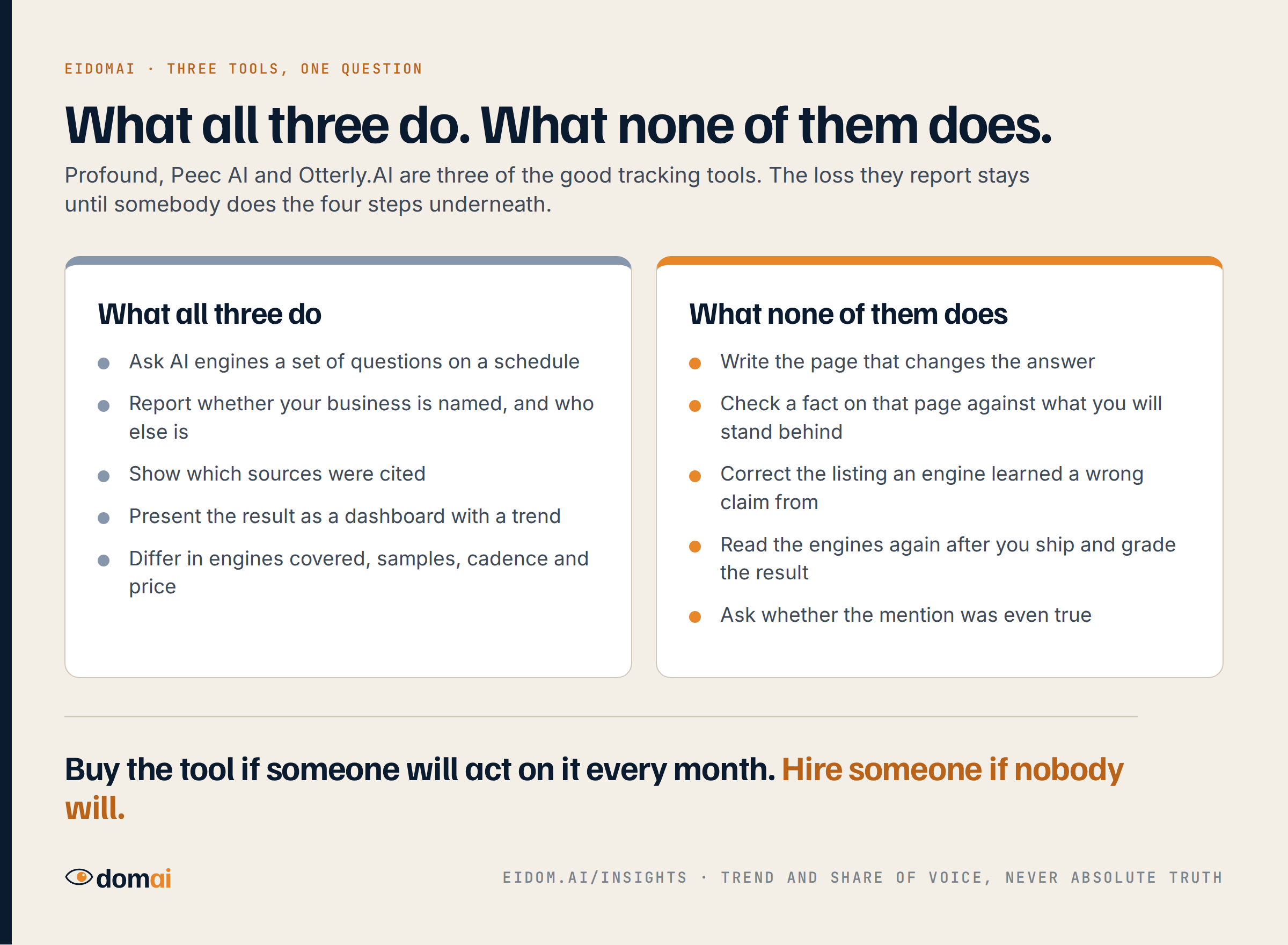
Each one asks AI engines a set of questions on a schedule and reports whether your business is named, who else is, and which sources were cited. Each presents the result as a dashboard with a trend. The good ones, and these are three of the good ones, do that reliably.
They differ in the details a buyer should check for themselves: which of the eight engines each covers, how many questions and how many samples per question, how often it runs, whether it separates a non-answer from a loss, and what a seat costs. We do not quote their features or prices here because they change, and a wrong claim about a competitor is a wrong claim.
What none of them does
None writes the page that changes the answer. None checks a fact on that page against what your business will stand behind. None corrects the directory listing an engine learned a wrong claim from. None reads the engines again after you ship and grades the result against what shipped.
Those four steps are the work. A tracking tool shows you the loss; the loss stays until somebody does the four steps.
The question underneath
Who, at your business, will write the page after the tool reports the loss? If there is a name, and that person can read a citation list and turn it into a page in the customer's words, a tracking tool is a good buy. So is Eidomai's The map, which is the same measurement plus a brief per page carrying the facts and the questions it has to answer.
If there is no name, a tracking tool is a subscription to bad news. Hire someone: an agency, a freelancer who understands the loop, or Eidomai's Done for you, where a person reads the map, writes the page from a fact sheet you confirmed, checks it with you, publishes it with the schema, corrects the sources, and reviews the result with you monthly.
The accuracy problem the tools skip
A tracking tool counts mentions. It does not ask whether the mention was true. In the measurement we ran before this site was indexed, the engines made 39 claims about Eidomai and all 39 were wrong. A small business gets the same treatment: a wrong phone number, a wrong service, a wrong city, repeated to a customer who never checks. Eidomai's monthly audit reads every claim and traces the wrong ones to their source. Ask any tool you are considering whether it does that.
How to decide
Run the free check. It asks ChatGPT and Claude the questions your customers ask and shows which answers name your business, which name a competitor, and what the engines get wrong. Then answer the one question about who writes. The modes page shows exactly who does what on The map and on Done for you, and you can move between them month to month.
Asked about this.
- What do Profound, Peec and Otterly have in common?
- All three track how AI engines answer a set of questions and report whether your business is named, who else is, and which sources were cited. They differ in which engines they cover, how many questions and how often, and how the results are presented. None of them writes a page, checks a fact against your business, or corrects a source. Those are the steps that change the answer.
- Is a tracking tool worth it for a small business?
- If someone at the business will act on what it reports every month, yes. If the report will sit unread, no. The measurement only has value when it leads to a page, a correction or a listing fix, and small businesses usually have nobody whose job that is.
- What does 'hire someone' look like?
- A person who runs the loop: measures, picks the question, writes the page from your facts, checks it with you, publishes it with the schema, fixes the listings, and measures again. That is Eidomai's Done for you plan. The map is the same measurement with your own team writing, and both are graded identically.