What to do
Step by step.
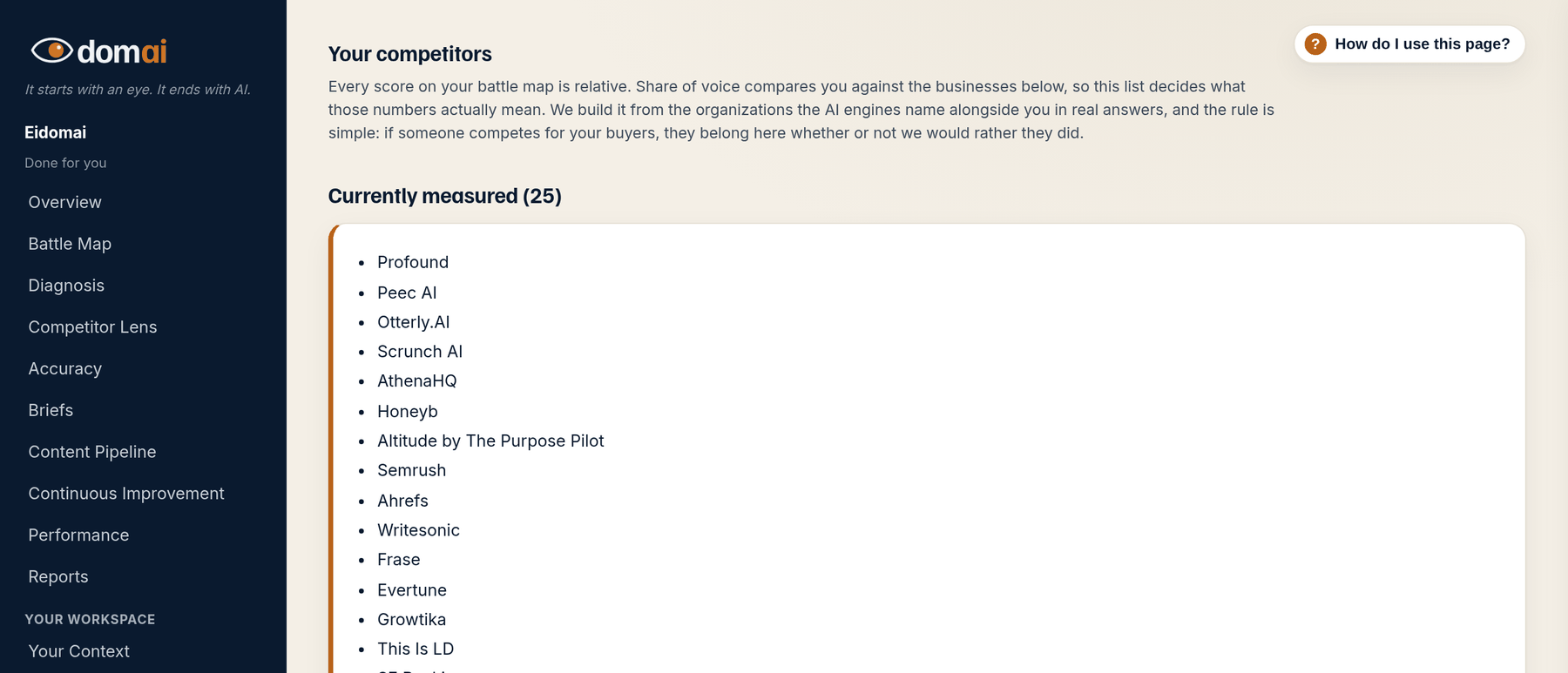
- On Your Competitors, find the name in the Currently measured table and open the selector in the What each one is to you column.
- Choose the relationship: competitor (they compete for the same buyers), affiliate (we are part of their network), parent organization, partner (we work together), directory or listing site, public body or regulator, a customer of ours, or not sure.
- It saves on its own. The confirmation reads that the name is recorded as that type, and that the diagnosis, lens and prompts follow it from the next export, usually within a day.
What happens next. From the next export, the Diagnosis plans, the Competitor Lens and the brief prompts treat each name by its relationship.
Not everything the engines name instead of you is a rival. A directory, a listicle, a partner, the network you belong to, the regulator that licenses you: all of them can hold a cell on your map, and each needs a different plan. The relationship column is where you say which is which.
It takes a minute per name and it changes what the plan says. A loss to a competitor is countered with a page. A loss to a directory is often a listing you can fix yourself, plus a page. A loss to a partner may not be a loss at all.
How to read it
What the screen is telling you.
- A competitor held answer is a loss to take back. A directory held answer is a listing to fix or a page to write that outdraws it. A partner or parent held answer may be fine as it is. The relationship is what tells the plan which.
- Competitor-owned sources are never outreach targets; those answers are countered with content. A directory or public body is often a source you can correct directly, and the correction plan says so.
- Not sure is an honest answer and the default. Set the ones you know; leave the rest.
Questions
People ask.
- A listing site holds most of my open cells. Is that bad?
- It is common and it is fixable. Mark it as a directory. The plan then splits into two: get the listing right (often your own login) and write the page that answers the question better than a list does.
- We are part of a network that gets named instead of us.
- Mark it as an affiliate. The lens stops counting it as a threat, and the brief for that question is written so the engine names you within the network rather than instead of it.
- Why does the relationship take a day to show?
- The diagnosis, the lens and the prompts are built by the engine's export, which runs daily. The relationship is saved at once; the views that read it refresh on the next export.