What to do
Step by step.
- Work top down. Questions are sorted by how much they matter and how far you are from being named, so the first few rows are the month's work.
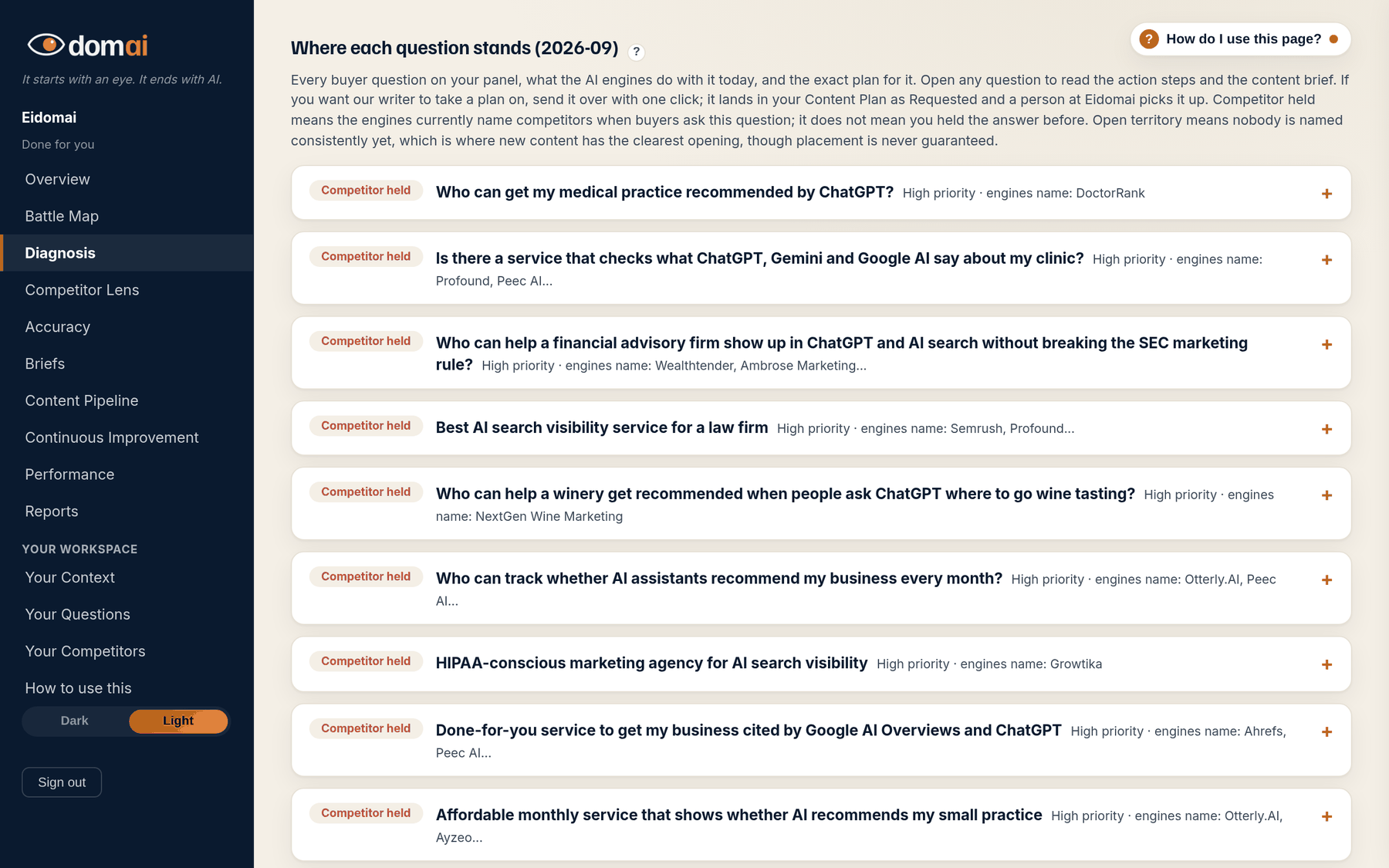
- Read the status pill on each row: You are named, Partly visible, Competitor held, Open territory. The line under it says which engines name you and which name someone else.
- Expand a question to read The action plan (numbered steps) and the Content brief behind it: the page that would earn the answer, with its structured data and call to action.
- On The map, press Start this task to open that question's own task on Briefs: the brief, the copy-ready prompt, the draft check and the ship marker. If a task already exists the button says Open this task. On Done for you, press Send this plan to our writer and it appears in your Content Pipeline as Requested; a person picks it up.
What happens next. Starting a task changes nothing on the map. The page you write from it, once shipped and re-measured, is what does.
The battle map says what happened. Diagnosis says why, one question at a time, and what to do about it. Every row is a measured question with its status, who holds it, what the engines cited when they answered, and a plan built from that.
The plan has two halves. The action steps are about sources: a listing to fix, a page to update, a directory that says the wrong thing. The brief is about the page: what would need to exist on your site for an engine to name you. The button at the bottom of the row is where the work starts, and it takes you to the Briefs tab with everything already filled in.
How to read it
What the screen is telling you.
- Competitor held plus a cited source you can influence is the fastest kind of gain: fix the source, and the engine has a reason to change. Competitor-owned sources are never outreach targets; those answers are countered with a page of your own.
- Open territory is the cheapest ground. Nobody is named consistently, so a page that answers the question plainly is often enough.
- You are named rows have no button. You hold that answer today and it is measured again every cycle.
- High, medium and low priority combine how much the question matters to your business with how many engines you are missing on.
Questions
People ask.
- Does the button write anything?
- No. On The map it opens the task with a prompt built from your verified facts; you or your writer write the page and the draft check scores it. On Done for you it starts a person. Nothing is auto-generated or published without your approval.
- Why does a question I care about sit low on the list?
- The order weighs importance against distance. A question you already hold, or one every engine answers in general terms, sits lower than one a single competitor is winning with a source you can fix. Start it anyway; the order is a suggestion.
- The plan mentions a source I cannot change.
- Some sources belong to a competitor or a publisher. The plan says which, and counters those with content rather than outreach. If a step still asks for something you cannot do, tell us with Send a note on the matching claim on Accuracy, or email hello@eidom.ai.