I ran search campaigns for a long time, and here is a thing I never once lost sleep over: ranking for the wrong term.
It happened constantly. A hospice client would show up on page one for an HVAC query because somebody had written "air quality" on a page about the facility. A winery would rank for a wedding venue two towns over. A law firm's careers page would surface for a question about a completely different law firm. We would notice, we would shrug, and sometimes we would not even bother to fix it. Why? Because nobody was fooled. A person searching for a furnace repair saw a hospice in the list, thought "that is not it," and kept scrolling. The wrong result cost the searcher half a second and cost us nothing at all.
That is the whole mechanism of search, and it is worth saying plainly because it is about to disappear. A search engine surfaced things. It put ten links in a row and made you the judge. The engine never said the hospice was an HVAC company. It just showed you a page and let you decide. Relevance was a suggestion. The verdict was yours.
An AI answer works the other way around. The engine is the judge. You ask who to call and it tells you, in a paragraph, in a voice that sounds like it knows. It does not surface a page and let you weigh it. It reads the pages for you, decides what they add up to, and states the result. "This company is a flat-fee real estate brokerage." "This organization provides hospice care and can be reached at this number." Statements. Full sentences. No list to scroll past, no second link to compare against, and in most engines no link at all.
So the same error that used to be harmless is now a claim. And a claim gets believed.
What we found when we counted
Before this product had a name, we ran the measurement on eighteen real businesses across the industries we work in: hospices, physical therapy practices, wineries, a childcare center, a real estate brokerage, foundations. Eight engines, the questions their customers actually ask, every answer saved word for word. Then we did the part the tracking tools skip. We read every factual claim the engines made about those businesses and checked it against a fact sheet the business had confirmed.
Three hundred and ninety-eight claims. Forty-eight flatly wrong. Not wrong in tone or emphasis. Wrong in fact.
A flat-fee real estate brokerage described to a buyer as a school bus technology platform. A childcare center described to parents as a hospital's donation program. A hospice given a phone number that belongs to somebody else. Twenty-nine of the 48 are quoted, names removed, in the wrong-answers library.
Read that list with the old search mindset and it looks like a collection of funny rankings. The brokerage "ranked" for school buses. So what. Read it the way the customer read it, as a sentence spoken by something they trust, and it is a different list. A parent asked where to send their kid and was told the place is a donation program. A family in the worst week of their lives asked for a hospice and was given the wrong phone number. Nobody in either case had a list of ten to fall back on. They had the answer, and the answer was wrong, and they acted on it or they did not. Either way, the business never heard about it.
That last part is the part that keeps me up now. A wrong ranking was visible. You could see it in the reports, you could laugh at it in the meeting. A wrong answer is invisible to you. It happens in someone else's chat window, it is never logged anywhere you can see, and the only evidence is a customer who never called.
Why the engines are confident when they are wrong
It helps to know why this happens, because it is not malice and it is not stupidity. An engine does not look you up. It assembles you from everything it has read that sits near your name: your pages, the directories that scraped you, a listicle from six years ago, a press release about a business that used to have your address. Then it writes a paragraph that makes all of that fit together. If the pieces contradict each other, it picks. If a piece is missing, it fills the gap with whatever usually fills gaps like that. The output is fluent either way, because fluency is what these things are built for.
So a stale listing does not produce a stale-sounding answer. It produces a confident, current-sounding answer with a stale fact in it. A directory that has your old phone number does not produce a hedge. It produces your old phone number, said plainly. The engine has no way to sound less sure about the parts it got from weak sources, and the reader has no way to tell which parts those were.
In search, weak sources ranked low and looked weak. In an AI answer, a weak source and a strong source come out in the same voice.
What changed in the job
For twenty years the job was to get surfaced, and accuracy was hygiene. Fix the obvious howlers, keep the listings roughly right, move on to the thing that mattered, which was rank. I did it that way and so did everyone I know.
Now being seen is half the job and being described correctly is the other half, and the second half is the one with the liability in it. That is a bigger change than it sounds, because it moves the work. Ranking work happened on your own site. Accuracy work happens wherever the engine learned the wrong thing, which is usually not your site: the directory, the aggregator, the old article, the profile somebody set up in 2019 and forgot. You cannot edit an engine. You can find the page that taught it, fix that page, and ask the engine again next month to see whether it learned.
That is the whole shape of what we do about it, and there is no shortcut in it. Read every answer, not a score of the answers. Check every claim against facts the business will stand behind. Trace each wrong claim to a source when there is one to find. Correct the source. Ask again. It runs every month on every account because the engines re-read the web every month, and a fact you fixed in March can come back in June from a page you did not know existed.
The short version
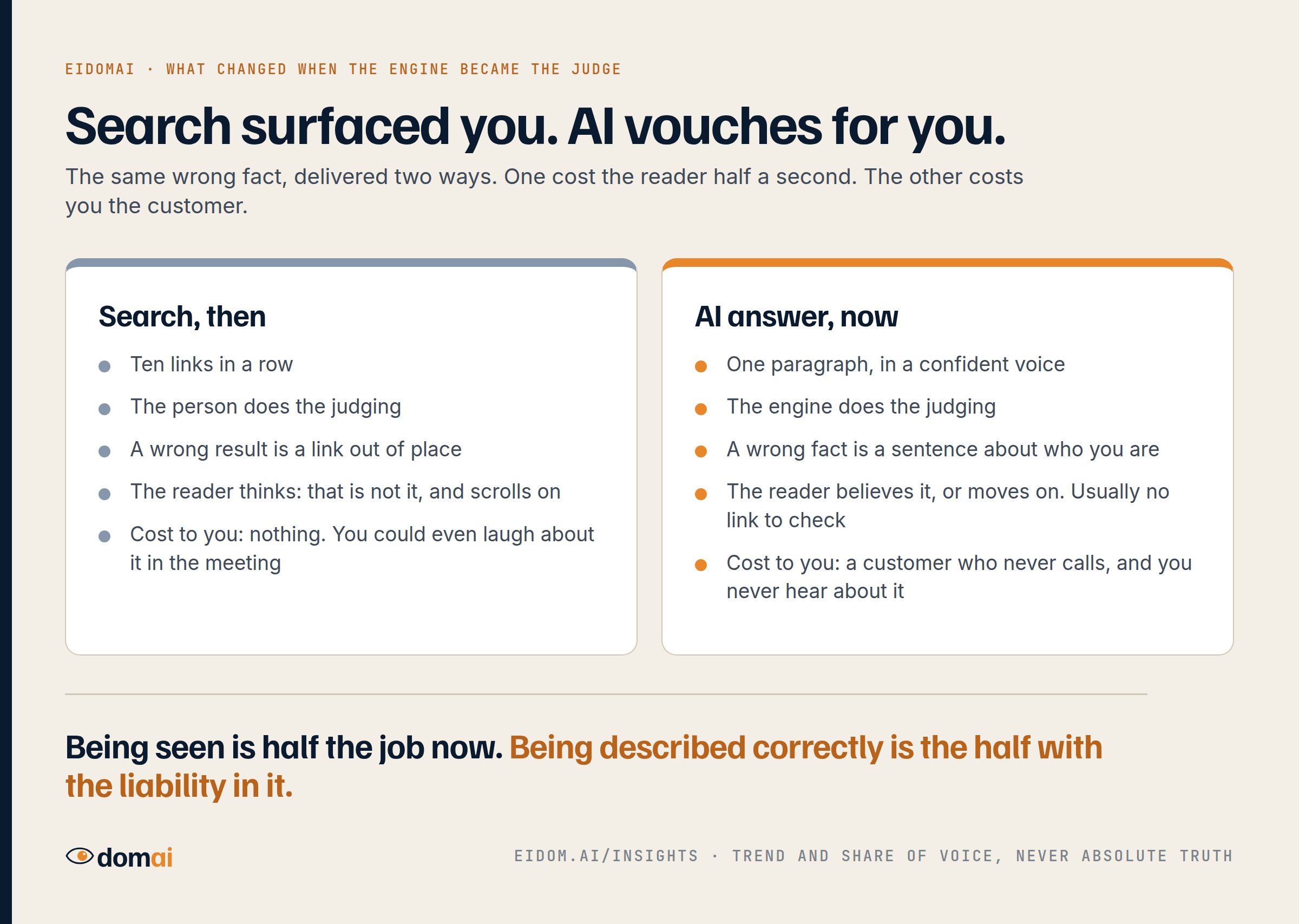
Search surfaced you and let the customer judge. AI vouches for you and the customer takes its word. A wrong ranking was a link out of place. A wrong answer is a statement about who you are, made to someone who was about to call, by something they trust more than they trust you.
We measure it because nobody else was counting, and we fix it at the source because that is the only place it can be fixed. If you want to know what the engines are saying about you right now, the free check reads two of them and shows you, word for word. Fair warning: the first thing most people find is a fact they thought was settled.
Asked about this.
- Why does it matter if AI gets facts wrong about my business?
- Because an AI answer is a statement, not a list. When a search engine ranked you for the wrong thing, the reader saw a link out of place and skipped it. When an AI engine describes you wrong, the reader hears a confident sentence about who you are and what you do, usually with no link to check, and they believe it or they move on. The error travels as fact.
- Is AI visibility the same as SEO?
- No. SEO surfaced a page and let the person judge it. An AI answer names a business and describes it in the engine's own words. Being visible is only half of it now; being described correctly is the other half, and it is the half that costs a customer who never calls to check.