Eidomai does, and this piece explains what the work is so you can judge us or do it yourself. When a patient asks ChatGPT which clinic to call about a specific problem, the engine names a practice whose public pages answer that problem in the patient's words, with facts the engine can verify across more than one source. Getting your practice named is the work of making that true, then measuring whether it worked.
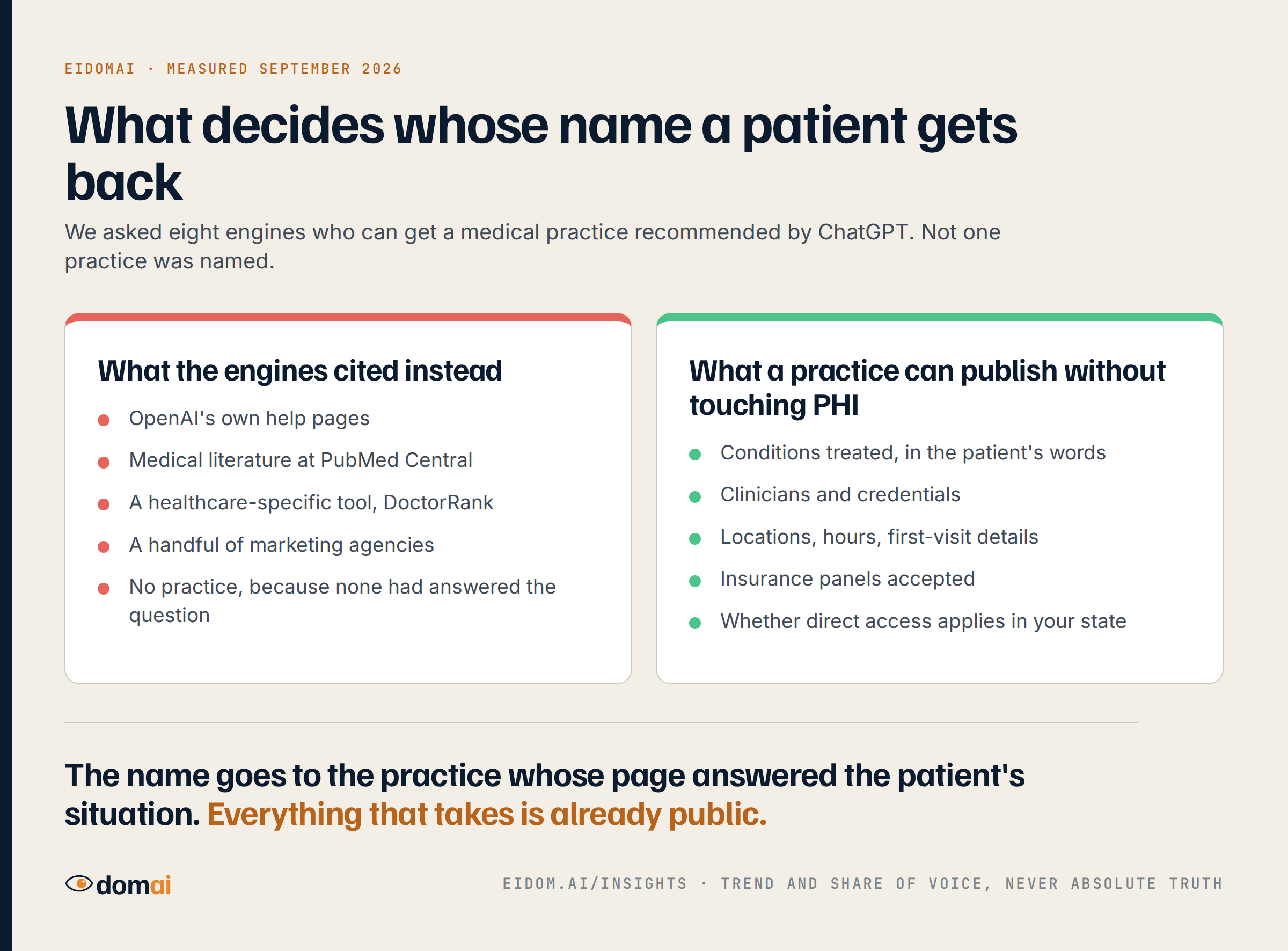
In our September 2026 measurement of this exact question, the winner across the engines was a healthcare-specific tool, DoctorRank, and the sources the engines cited were OpenAI's own help pages, medical literature at PubMed Central and a handful of marketing agencies. No practice was named. That is the opening: the engines are describing the category because they have not been given a practice to name.
What the patient actually asks
Patients do not ask "best medical practice". They ask with their situation attached. Whether they need a referral for physical therapy after a knee surgery. Which pediatric clinic near them takes their plan and has weekend hours. Whether a dermatology practice does the specific procedure their friend mentioned. Each of those has a name as the answer, and the name goes to the practice whose page answered.
Eidomai's first step is to write twelve to twenty of those questions for your practice, from your services and your market, and show them to you. You confirm them or replace them. The questions you never thought to ask are usually the point.
What decides whose name it is
Eight engines, asked the same questions, cite the same kinds of sources: the practice's own site, the directories (Healthgrades, Zocdoc, the insurer's provider finder, Google's business profile), the hospital or association pages that list you, and the pages that already rank. When those agree, the engine names you with confidence. When they disagree, or when your own site describes a category rather than an answer, the engine reaches for whoever did answer.
That is why the battle map is per question. For each one, Eidomai shows which engines name you, which name a competitor, who that is, and which domains taught them. The practice that wins ACL rehab may lose pediatric same-day visits to a clinic across town, and the map shows both.
What a HIPAA-conscious practice can publish
Everything the work needs is already public or is yours to state: the conditions you treat, the clinicians and their credentials, the locations and hours, the insurance panels you accept, whether direct access applies in your state, what a first visit involves. None of it touches protected health information. Eidomai never asks for patient data and never uses it; the measurement reads public AI answers, and the pages we write are built from facts you confirmed on a sheet you can read.
Reviews and testimonials are the one area to treat with care, and a practice's own compliance rules govern what it quotes. The pages that win these questions rarely need them. A plain statement of what you do and for whom, in the patient's words, does the work.
Who does it
On The map, Eidomai measures monthly, shows you the battle map and the accuracy audit, and hands you a brief for each page worth writing, with the facts and the questions it has to answer. Your team writes and publishes. On Done for you, a person at Eidomai reads the map, writes the pages, checks every fact with you before anything publishes, corrects the sources that taught the engines something wrong, and reviews the results with you monthly. The whole process is on the how it works page; nothing about it is secret.
The one thing to do this week
Ask ChatGPT and Claude the questions your patients ask and read who they name. The free check does that for you and shows the results in a login, with one wrong claim about your practice if there is one. No call required. If the answer names a competitor, you now know which of the three reasons applies, and the companion piece walks through each.
Asked about this.
- Is there a service that checks what ChatGPT, Gemini and Google AI say about my clinic?
- Yes. Eidomai's free check asks ChatGPT and Claude the questions your patients ask and shows which answers name your clinic. On a plan, all eight engines are asked every month, including Gemini, Google AI Overviews and Google AI Mode, and every factual claim about your clinic is checked against facts you confirmed.
- Does AI visibility work involve patient data?
- No. Eidomai reads public AI answers and public pages about your practice. Nothing from your EHR, your patient list or your intake forms is used or requested. The pages we write state the services, credentials, locations and insurance panels you have confirmed, and nothing else.
- Can ChatGPT recommend a specific doctor?
- It does, when a patient asks for one and the sources support it. It names practices more often than individual clinicians, and it names the ones whose pages answer the patient's situation directly. A clinician page with credentials, conditions treated and accepted insurance is what gives it something to cite.