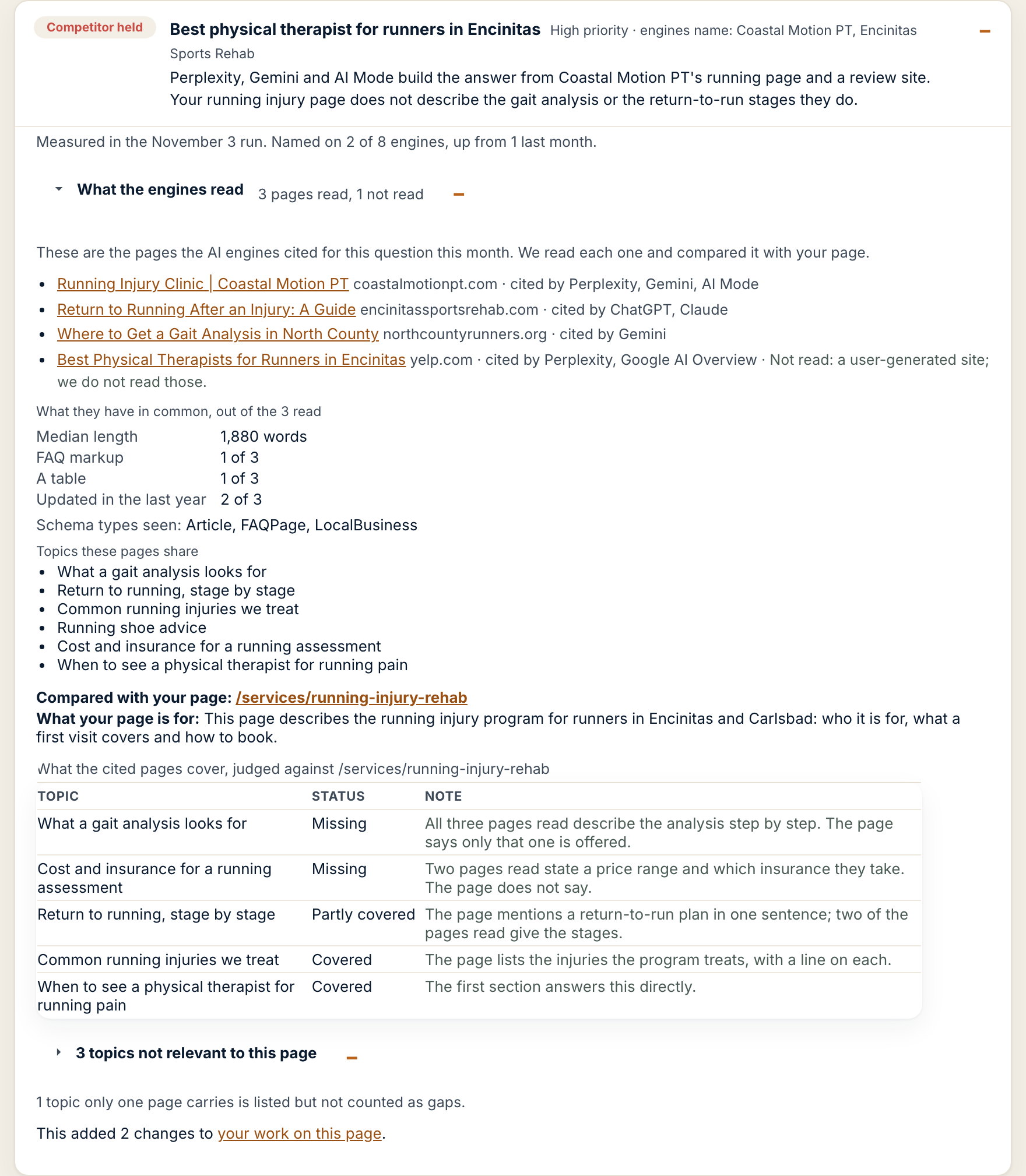
Step by step.
- Open a question on the Work list and press What the engines read, under the status line. The count beside it says how many pages were read and how many were not.
- Read the pages. Each one shows its title, its site and which engines cited it. A page marked Not read says why, in plain words.
- Read What they have in common. The counts are out of the pages read, written as 1 of 3, never as a percentage: the median length, how many carry FAQ markup, how many carry a table, how many were updated in the last year, and the schema types seen.
- Read Topics these pages share. They are the headings the cited pages have in common, in the pages' own words.
- On The Map and Done for you, read Compared with your page: the page of yours closest to the question, what it is for, and a table of each shared topic marked Covered, Partly covered or Missing on your page. When the comparison added changes, the line under the table says how many and links to your work on that page.
What happens next. The changes this block adds carry the chip From the pages AI cites on the page's dossier, beside the changes from the ranking pages. Give each one an owner, edit the copy if you want it in your words, and mark it done when it is live. Nothing here changes your site until you do.
The Work list says why you are not the answer. What the engines read shows the evidence: the pages the AI engines cited for the question this month, read by us the way an engine reads them. The block lists the pages, what they have in common and the topics they share. On The Map it also compares them with your page and turns the gaps into changes on that page's dossier.
Three rules hold on every line of it. A page someone else owns is evidence, never a fact about you and never a place to seek a mention. No text from those pages reaches your screen, only titles, counts and the topics they share. And a page we could not read says so, with the reason, because unknown is not a mark against anyone.
What the screen is telling you.
- A cited page is evidence, not a fact about you and not a target. We read it to learn what the engines build the answer from. Nothing in this block asks you to seek a mention on someone else's site, and a competitor's page is never an outreach target.
- Not read always carries a reason: a user-generated site we do not read (a review site, a forum), a site that blocked our reader, a PDF, a page that is gone, a site that was down when we read it, or a page over this month's reading cap. A page we could not read is unknown. It does not count for or against anyone.
- The counts are out of the pages read. 1 of 3 means one of the three pages we read, so a month with one page read says little on its own.
- A topic only one page carries is listed but never counted as a gap. A topic becomes a change on your page only when at least two of the cited pages carry it, or when two or fewer pages were read.
- Not relevant topics are folded under the table with a count. They belong to another intent or another kind of business, so they are not gaps on your page.
- On The Scan, the free check and a demo map, you see the pages and what they have in common. The comparison with your page, the table and the changes are on The Map.
People ask.
- Should I ask one of these sites to mention us?
- No. The pages are there to show what an answer is built from. A competitor's page is never an outreach target, and a directory or a publication that states a wrong fact is handled by the correction plan on Accuracy. The work this block points at is on your own page.
- Why does a question show no block?
- The block appears once the pages for that question have been read, which happens with the monthly run. A question measured before this was added, or one whose cited pages were all on the not-read list, shows none. The block is switched on per account. If you want it and do not see it, send a support request.
- Why is a page marked Not read?
- The reason is printed next to it. We do not read user-generated sites such as review sites and forums, some sites block readers, and a PDF is not a web page. There is also a monthly reading cap per account. A page not read is unknown; it does not count for or against anything.
- The table says a topic is Missing, but my page covers it.
- The read is against the page as it was when the cited pages were read, and a topic is matched by what the page says, not by a keyword. If a heading or a paragraph of yours covers it in different words, decline the change on the dossier with a reason, and the next run re-reads the page.